Bought With Bonds
OpenAI's biggest outside backer just finished paying for its stake. With borrowed money. Layer on layer of it.
The bet
SoftBank finished paying for its stake in OpenAI with borrowed money. Its own filings show four layers of borrowing under the bet, and beside them up to $105 billion of guarantees from Nvidia, the company selling the chips.
In February, SoftBank promised OpenAI thirty billion dollars more. Three payments of ten billion. April, July, October.
When it was done, SoftBank had put in $64.6 billion. For about thirteen percent of the company.
Source: SoftBank Group Corp., press releases of 27 February, 27 March, 1 April, 1 July, 9 September, 24 September and 1 October 2026 (https://group.softbank/en/news/press) and the Consolidated Financial Report for the three months ended 30 June 2026; read at source 24 October 2026
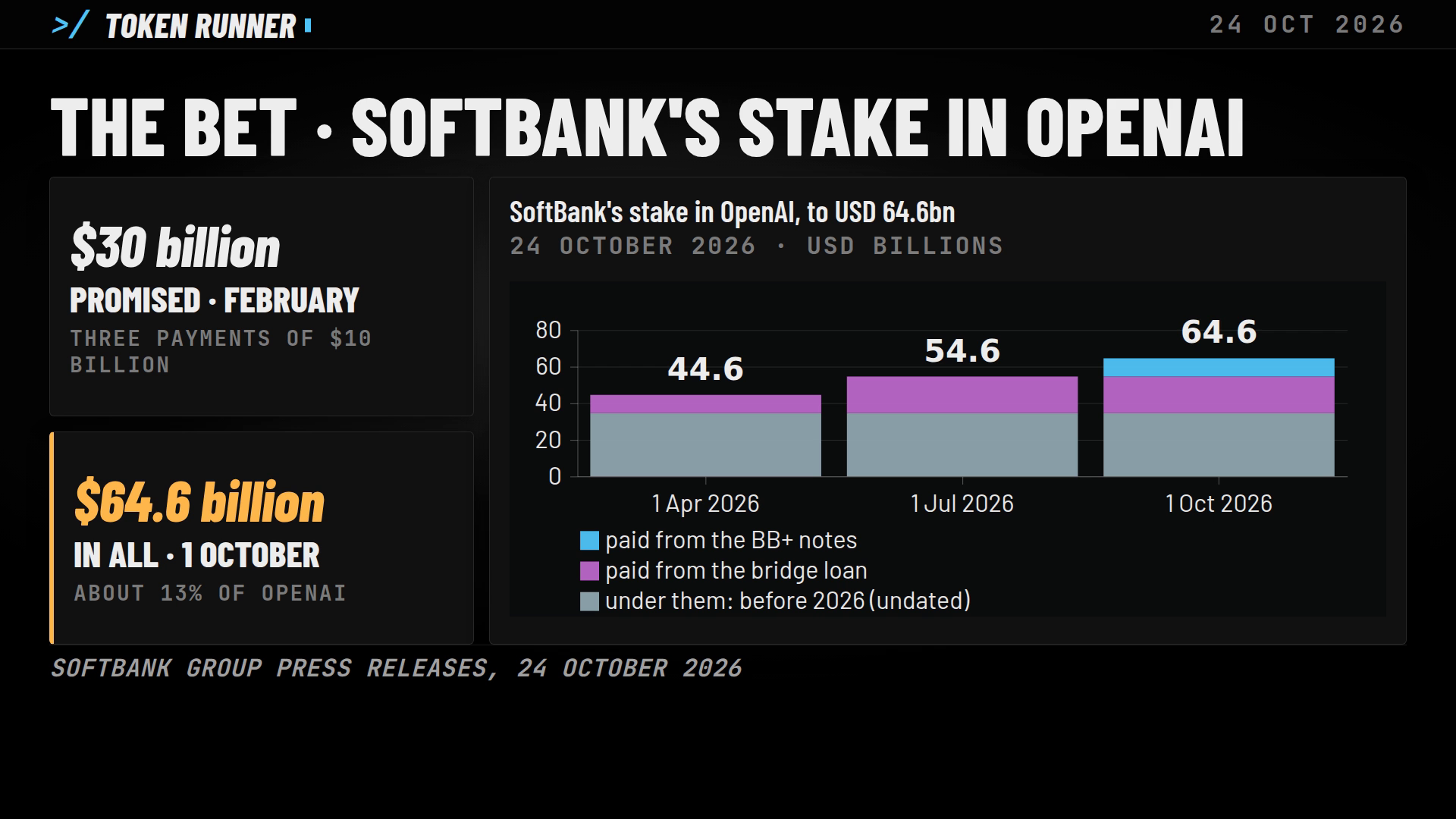
The payments went in on 1 April, 1 July and 1 October 2026. The bridge loan paid for the first two. Bonds rated BB+ paid for the third. The money SoftBank put in before 2026 is not dated in these releases, so the chart draws it as one undated block.
The bridge
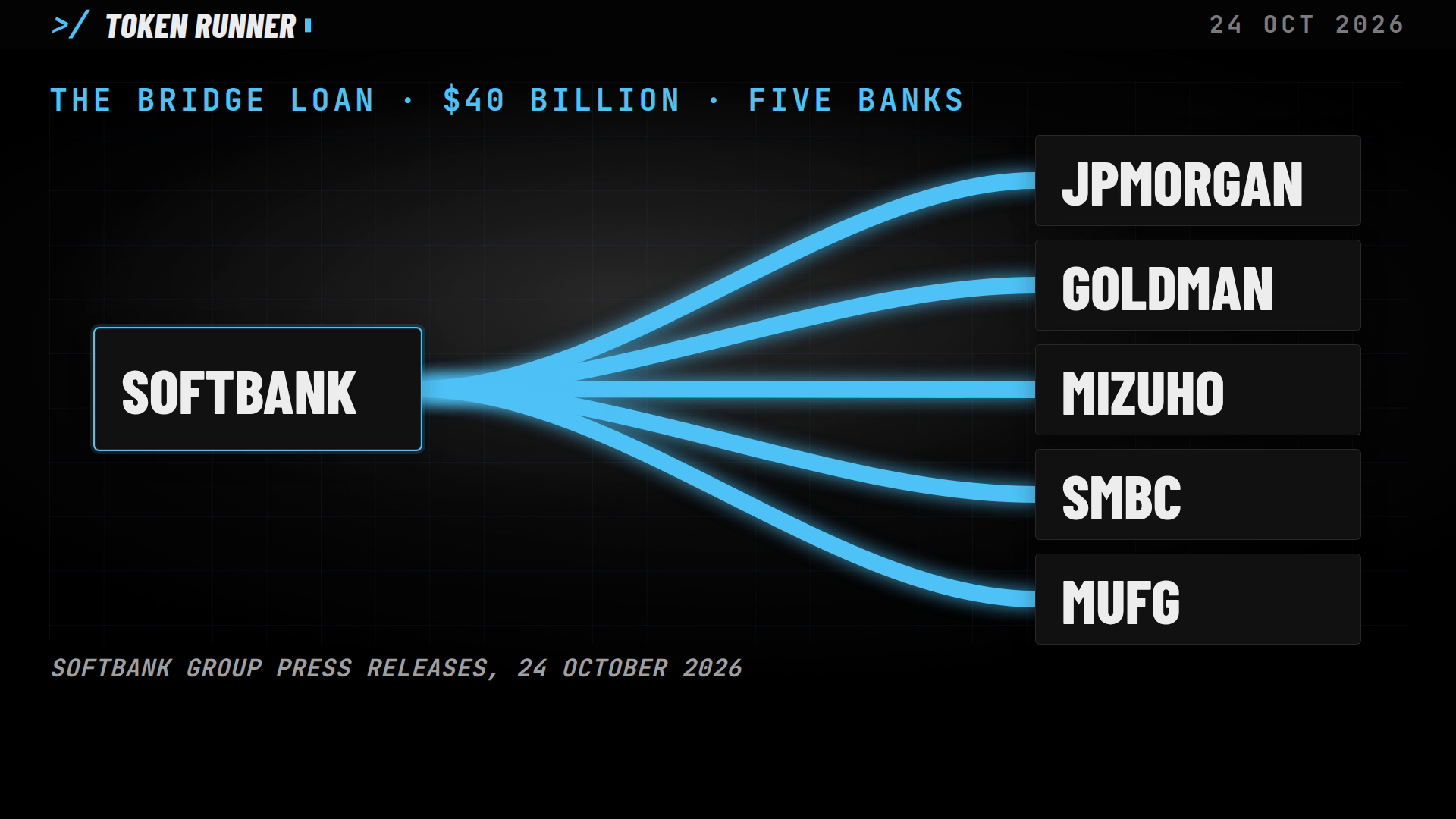
Layer one. A forty billion dollar bridge loan, from five banks. JPMorgan. Goldman Sachs. Mizuho. Sumitomo Mitsui. MUFG.
The first two payments were drawn on it. One borrower, five lenders, one purpose: SoftBank's release names the facility as primarily for the follow-on investments in OpenAI.
SoftBank signed the facility on 27 March 2026, to run to 25 March 2027. It drew ten billion dollars on 1 April and ten billion more on 1 July. On 15 September it prepaid the whole outstanding balance, $25.9 billion. By 1 October it had repaid every borrowing under the facility and cancelled the undrawn ten billion.
The April notes
Layer two. By April, SoftBank was already selling bonds to pay that bridge down. Rated BB plus. One step below investment grade.
Source: SoftBank Group Corp., press releases of 27 February, 27 March, 1 April, 1 July, 9 September, 24 September and 1 October 2026 (https://group.softbank/en/news/press) and the Consolidated Financial Report for the three months ended 30 June 2026; read at source 24 October 2026
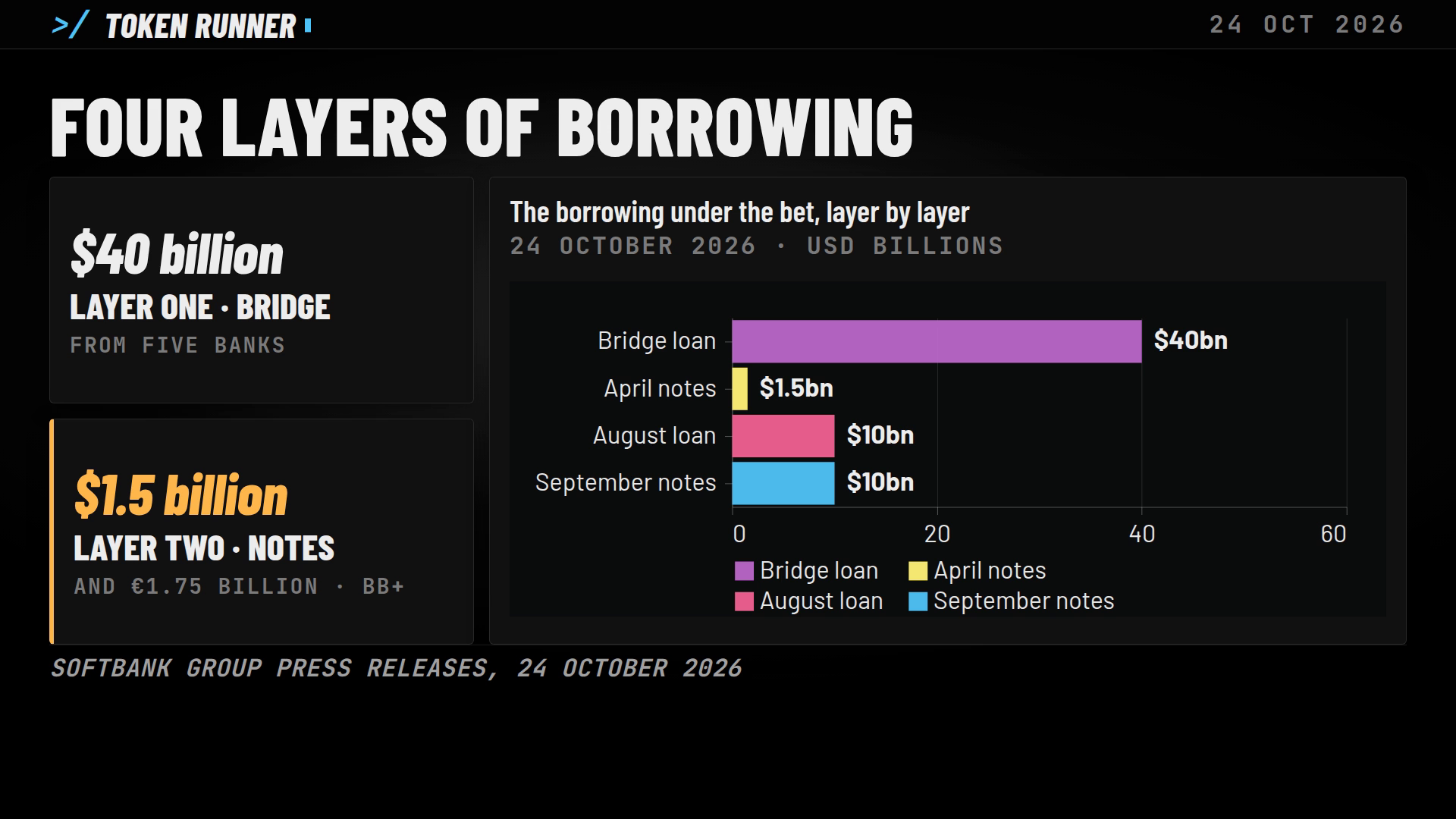
On 16 April 2026 SoftBank sold six tranches of senior notes: 400 million dollars due 2029 at 7.625 per cent, 600 million due 2031 at 8.25 per cent, 500 million due 2036 at 8.5 per cent; 700 million euros due 2030 at 6.375 per cent, 600 million euros due 2032 at 7 per cent, 450 million euros due 2034 at 7.375 per cent. That is $1.5 billion and €1.75 billion in all, rated BB+ by S&P. The release states the purpose: "for the partial repayment of the amount outstanding under the bridge loan primarily for the follow-on investments in OpenAI".
The loan with a trigger
Layer three. In August, a ten billion dollar loan, guaranteed by SoftBank itself. Read the fine print in SoftBank's own report.
If the value of its OpenAI shares falls significantly, SoftBank must put up cash, or pay early.
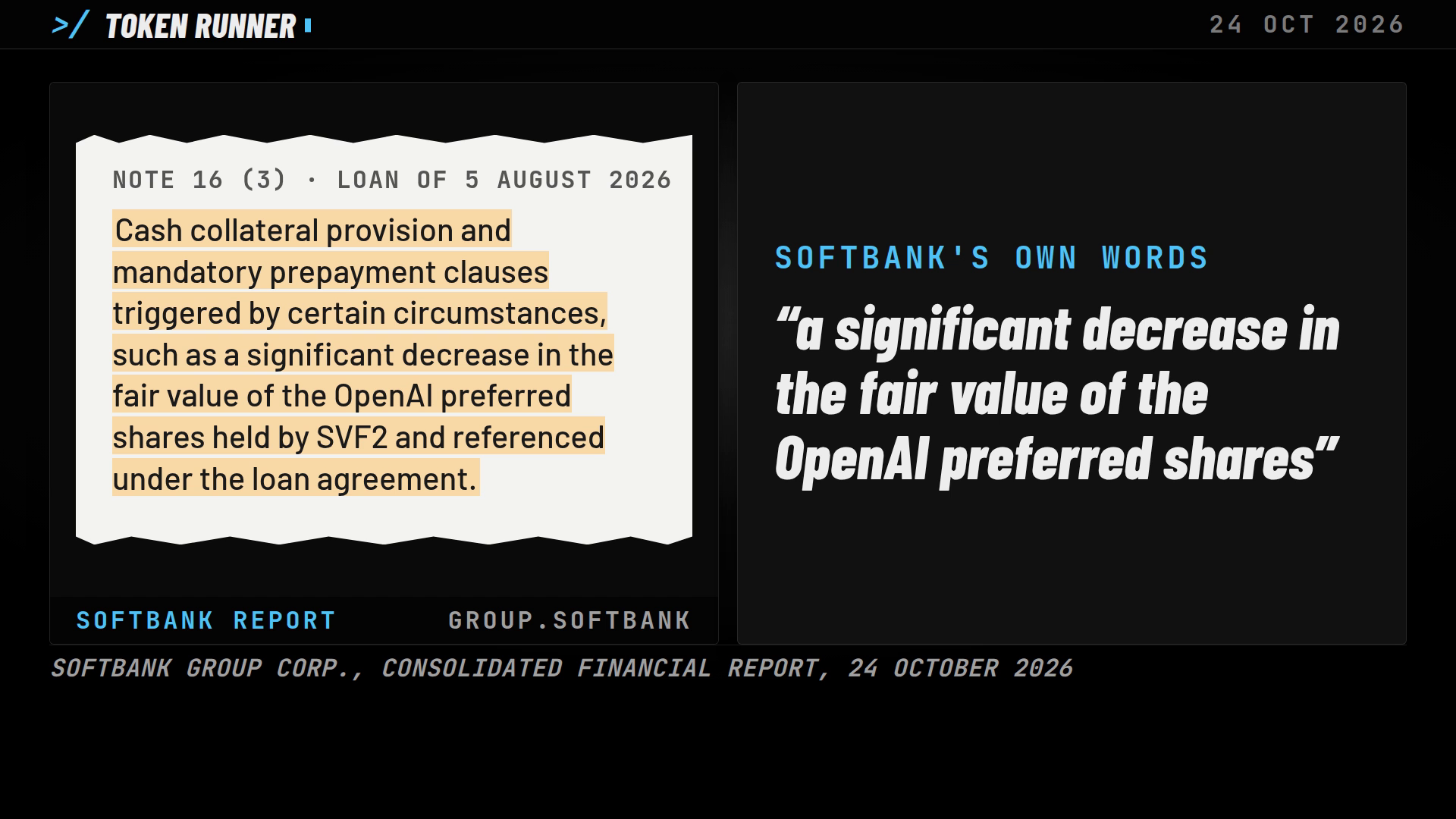
SoftBank's quarterly report to 30 June 2026 records the agreement of 5 August 2026. A wholly owned subsidiary of SoftBank Vision Fund 2 borrows ten billion dollars. Five arrangers lead it: Goldman Sachs Bank USA, JPMorgan Chase Bank, Mizuho Securities USA, Apollo Global Funding and Sumitomo Mitsui Banking Corporation. The loan was drawn in August and falls due in August 2028. SoftBank Group guarantees it, and a cash collateral account secures it. Its key covenant, in the report's words: "Cash collateral provision and mandatory prepayment clauses triggered by certain circumstances, such as a significant decrease in the fair value of the OpenAI preferred shares held by SVF2 and referenced under the loan agreement." The report gives no interest rate.
“Cash collateral provision and mandatory prepayment clauses triggered by certain circumstances, such as a significant decrease in the fair value of the OpenAI preferred shares held by SVF2 and referenced under the loan agreement.”
SoftBank Group Corp., consolidated financial report for the three months to 30 June 2026, note 16 (3), the loan of 5 August 2026 · read 24 October 2026
The September notes
Layer four. In September, eleven billion dollars more of bonds. And this time, SoftBank says plainly, for the last ten billion dollar payment to OpenAI.
Eight point six two five percent. Nine point two five. Nine point seven five.
Source: SoftBank Group Corp., press releases of 27 February, 27 March, 1 April, 1 July, 9 September, 24 September and 1 October 2026 (https://group.softbank/en/news/press) and the Consolidated Financial Report for the three months ended 30 June 2026; read at source 24 October 2026
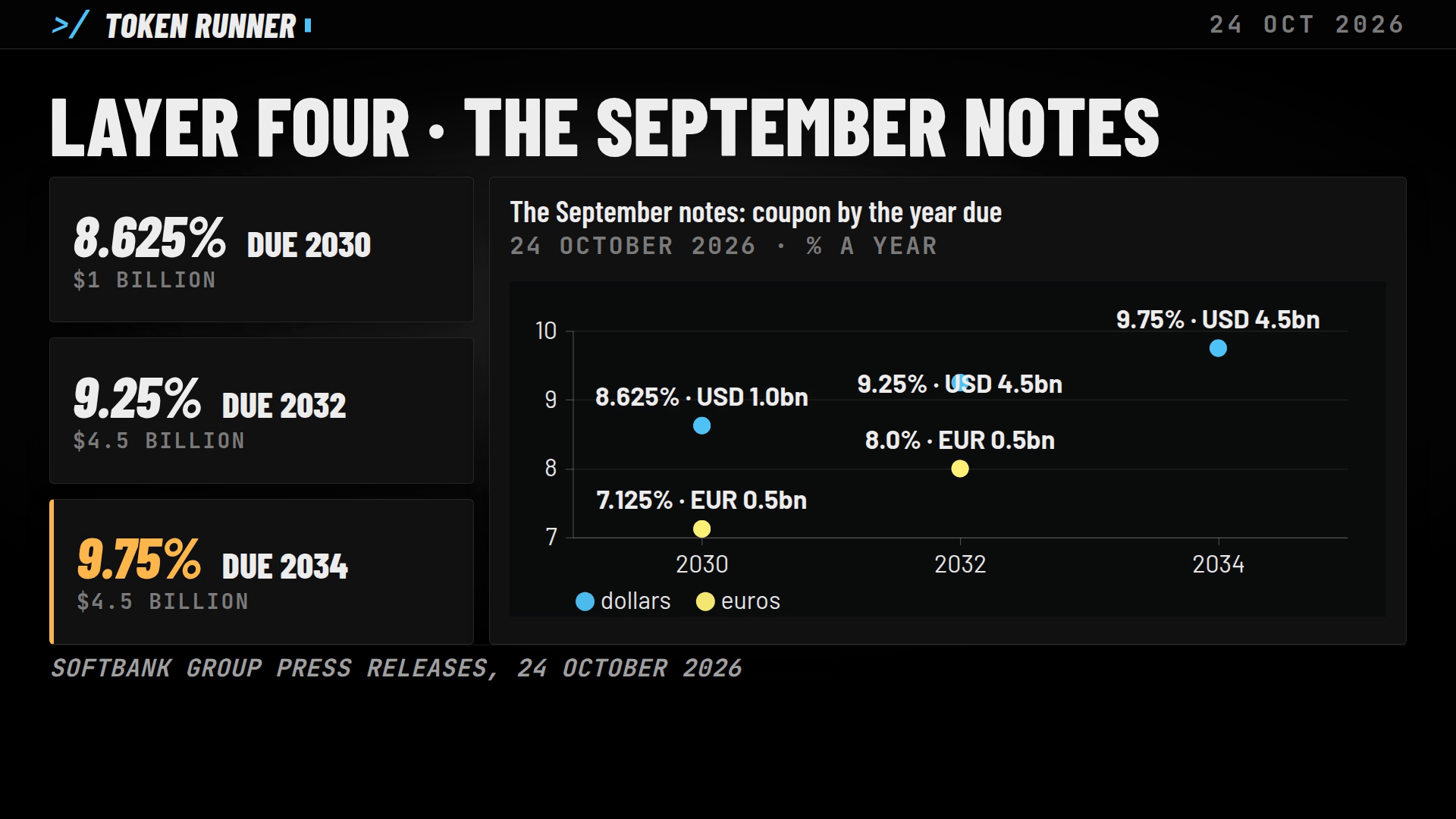
SoftBank sold five notes on 24 September 2026: 1,000 million dollars due 1 April 2030 at 8.625 per cent, 4,500 million due 1 April 2032 at 9.25 per cent, 4,500 million due 1 April 2034 at 9.75 per cent; 500 million euros due 1 October 2030 at 7.125 per cent and 500 million euros due 1 October 2032 at 8 per cent. That is $10 billion of dollar notes and €1 billion of euro notes, about 11.1 billion dollars in all. S&P Global Ratings Japan and Fitch Ratings Japan both rate them BB+. The release gives the purpose: "For funding the USD 10 billion payment for the third and final tranche" and general corporate purposes. SoftBank's release of 1 October says the third payment was "funded with the proceeds from the issuance of foreign currency-denominated senior notes".
Our arithmetic
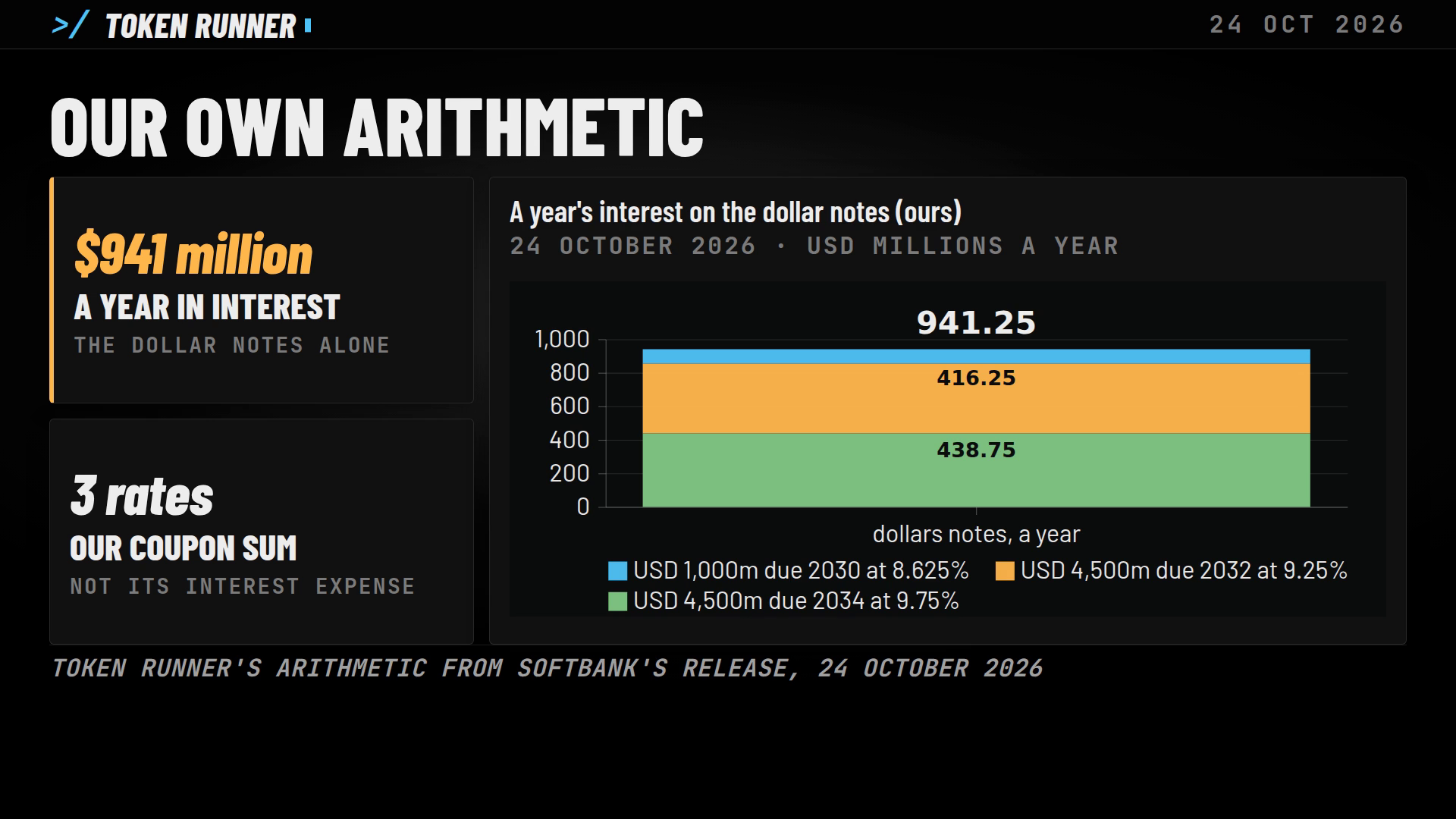
Our own arithmetic, from those three rates. About $941 million a year in interest. On the dollar notes alone.
Line by line: 1,000 million dollars at 8.625 per cent is 86.25 million a year; 4,500 million at 9.25 per cent is 416.25 million; 4,500 million at 9.75 per cent is 438.75 million. Together, 941.25 million dollars a year until the notes come due in 2030, 2032 and 2034. The euro notes add about 75.6 million euros a year. It is a coupon sum, not SoftBank's reported interest expense. Spread over a year, that is about 78 million dollars a month, or about 2.6 million a day, before the euro notes. Carried to each maturity, the coupons add up: about three and a half years of the 2030 note is about 302 million dollars, five and a half of the 2032 note about 2,289 million, seven and a half of the 2034 note about 3,291 million; about 5.9 billion dollars in interest alone, by the same arithmetic, before the euro notes.
Source: SoftBank Group Corp., press releases of 27 February, 27 March, 1 April, 1 July, 9 September, 24 September and 1 October 2026 (https://group.softbank/en/news/press) and the Consolidated Financial Report for the three months ended 30 June 2026; read at source 24 October 2026
The whole stack
The four layers sit on a bigger pile. SoftBank's quarterly report to 30 June 2026 lists the main interest-bearing debt of its holding company segment at that date. SoftBank Group itself owed borrowings of 3,100.9 billion yen, corporate bonds of 8,897.3 billion yen and commercial paper of 233.8 billion yen. Its wholly owned financing subsidiaries, each nonrecourse to the parent, owed more: bridge loans for the follow-on investments in OpenAI, 1,119.3 billion yen; a margin loan backed by Arm shares, 3,221.0 billion yen; a margin loan backed by SoftBank Corp. shares, 1,197.0 billion yen; prepaid forward contracts backed by T-Mobile shares, 265.6 billion yen; and SB Northstar's prime brokerage loans, 684.9 billion yen.
Interest expenses at SoftBank Group rose by 135,531 million yen in the quarter. The report gives the reason: "primarily due to interest on $11.5 billion borrowed in December 2025 through the margin loan backed by Arm shares and on $20.0 billion drawn under bridge loans in April 2026, as well as a higher outstanding balance of corporate bonds".
The Ohio campus
And it does not stop at SoftBank's door.
In Ohio, SoftBank's own SB Energy is building a campus for OpenAI. Four point two five gigawatts.
Source: SoftBank Group Corp., press releases of 27 February, 27 March, 1 April, 1 July, 9 September, 24 September and 1 October 2026 (https://group.softbank/en/news/press) and the Consolidated Financial Report for the three months ended 30 June 2026; read at source 24 October 2026
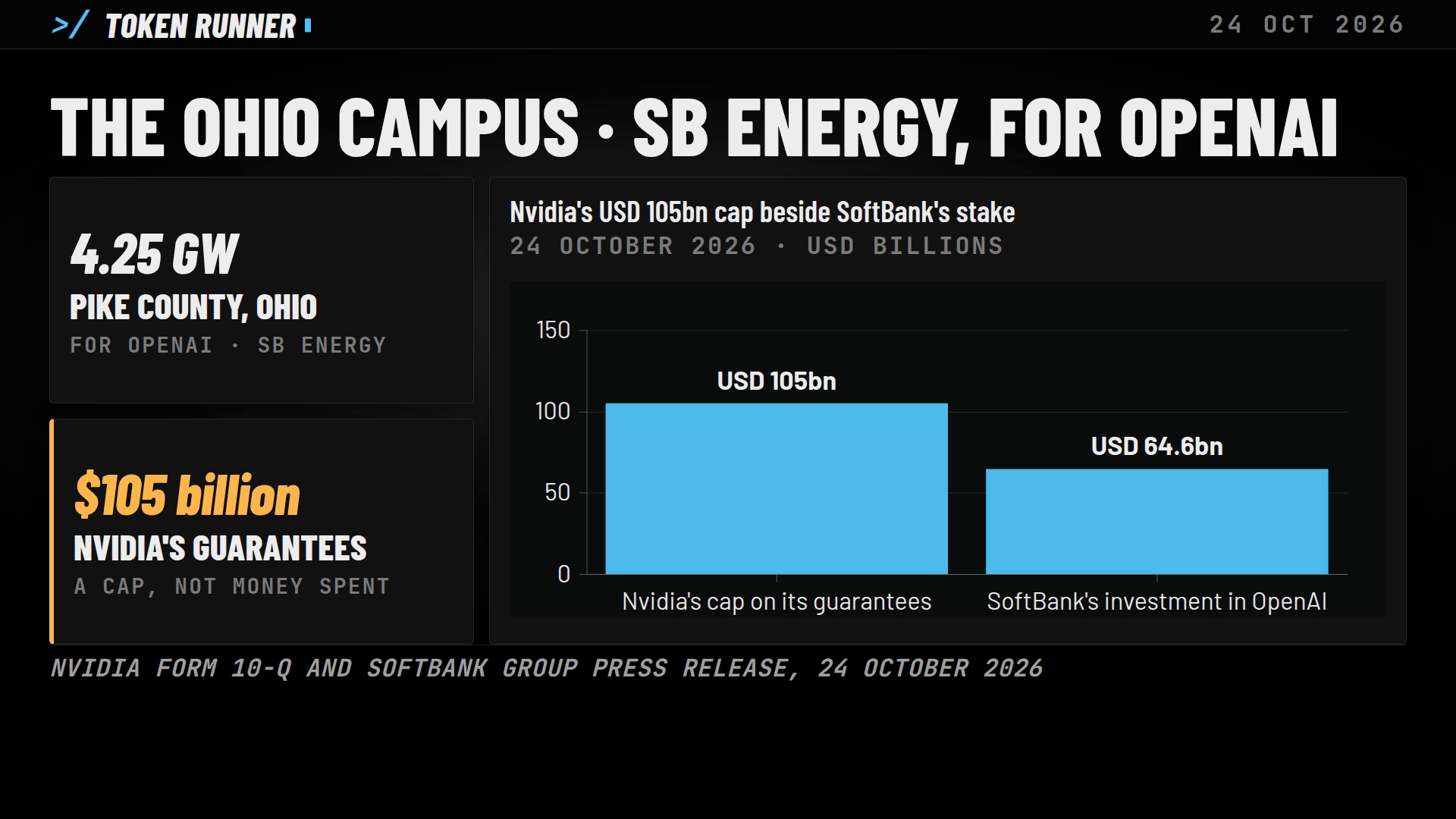
Nvidia's own filing says it has guaranteed up to $105 billion for it. And the site will exclusively host Nvidia's chips.
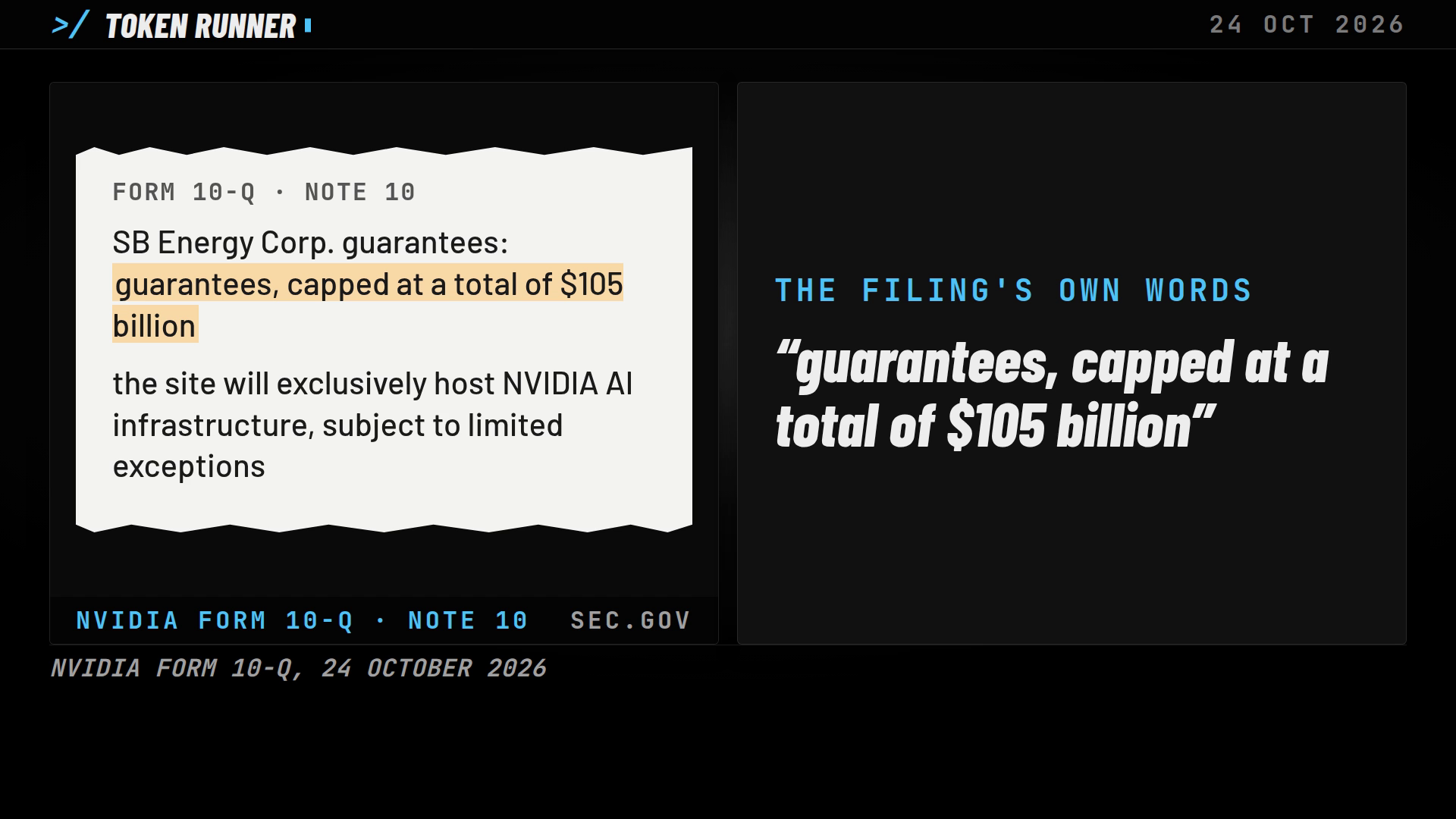
Nvidia's quarterly report for the quarter ended 26 July 2026 records that in August 2026 it "entered into guarantees, capped at a total of $105 billion, to provide credit support on a land, power, and shell buildout with affiliates of SB Energy Corp. (SB Energy) on behalf of a customer, an affiliate of OpenAI Group PBC (OpenAI), related to leases for approximately 4.25 gigawatts of IT load in the aggregate at SB Energy's PORTS Technology Campus in Pike County, Ohio", and that "the site will exclusively host NVIDIA AI infrastructure, subject to limited exceptions".
“guarantees, capped at a total of $105 billion”
NVIDIA Corporation, Form 10-Q for the quarter ended 26 July 2026, note 10, filed 26 August 2026 · read 24 October 2026
The guarantees cover defined portions of lease and power payments, phase by phase from Nvidia's fiscal 2029. They end when OpenAI reaches a satisfactory credit rating or the leases run out. Nvidia's filing names SB Energy and OpenAI. That SB Energy is "a subsidiary of SoftBank Group Corp." is SoftBank's own word, in its release of 2 September 2026.
What one investor said
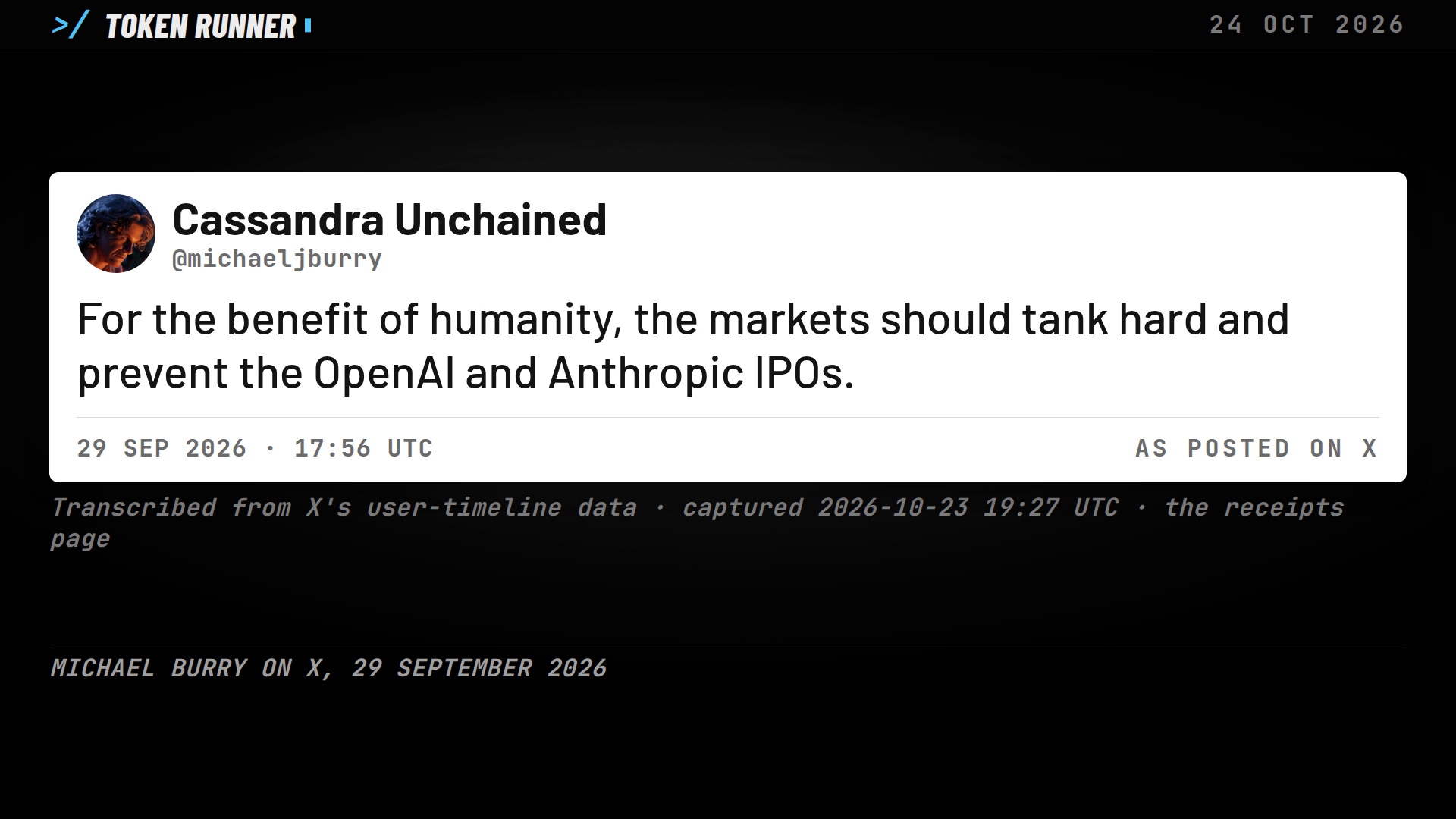
The investor who called the last bubble, Michael Burry, put it this way:
"For the benefit of humanity, the markets should tank hard and prevent the OpenAI and Anthropic IPOs."
He posted it on X on 29 September 2026. We read it through X's own interface for developers on 24 October. A disclosure: Token Runner's agents run on Claude, made by Anthropic.
What this does not say
To be fair, the interest is SoftBank's cost, not OpenAI's. A guarantee is not money spent. And nothing here says SoftBank cannot pay.
SoftBank's release of 9 September does not say what funded the bridge's early repayment, and neither does this piece.
What it is built on
But look at what it is built on. A bridge. Junk bonds, rated BB+. A loan with a trigger tied to one company's shares. A hundred-billion-dollar guarantee from the company selling the chips.
The AI boom used to run on cash. This bet runs on credit.
What to watch
Three things to watch. The August loan's trigger, which turns on the fair value of SoftBank's OpenAI shares until the loan falls due in August 2028. Whether OpenAI reaches the credit rating that ends Nvidia's guarantees. And the coupons, which run until the dollar notes fall due in 2030, 2032 and 2034.
Every figure from SoftBank's and Nvidia's own filings.
Sources
- SoftBank Group Corp., "Follow-on Investments in OpenAI", press release, 27 February 2026: USD 30.0 billion through SoftBank Vision Fund 2 in three tranches of USD 10 billion on 1 April, 1 July and 1 October 2026; cumulative investment USD 64.6 billion and an ownership interest of approximately 13% after completion; funded first by bridge loans and other financing arrangements.
- SoftBank Group Corp., "Execution of Bridge Facility Agreement Primarily for the Follow-on Investments in OpenAI", press release, 27 March 2026: USD 40.0 billion from JPMorgan Chase, Goldman Sachs, Mizuho Bank, Sumitomo Mitsui Banking Corporation and MUFG Bank, maturing 25 March 2027.
- SoftBank Group Corp., "Execution of Follow-on Investment (First Tranche) in OpenAI", press release, 1 April 2026: USD 10.0 billion (JPY 1,588.7 billion), borrowed under the bridge facility.
- SoftBank Group Corp., "Execution of Follow-on Investment (Second Tranche) in OpenAI", press release, 1 July 2026: USD 10.0 billion (JPY 1,627.3 billion), borrowed under the bridge facility.
- SoftBank Group Corp., "Early Repayment of Bridge Loans", press release, 9 September 2026: the entire outstanding balance of USD 25.9 billion prepaid on 15 September 2026; USD 30.0 billion of the facility had been drawn. The release does not say what funded the repayment, and this piece does not.
- SoftBank Group Corp., "Issuance of Foreign Currency-Denominated Senior Notes", press release, 24 September 2026: about USD 11.1 billion (JPY 1,763.2 billion); USD 1,000 million due 1 April 2030 at 8.625%, USD 4,500 million due 1 April 2032 at 9.250%, USD 4,500 million due 1 April 2034 at 9.750%, EUR 500 million due 1 October 2030 at 7.125%, EUR 500 million due 1 October 2032 at 8.000%; rated BB+ by S&P Global Ratings Japan and BB+ by Fitch Ratings Japan; for funding the USD 10 billion payment for the third and final tranche and general corporate purposes.
- SoftBank Group Corp., "Execution of Follow-on Investment (Third Tranche) in OpenAI", press release, 1 October 2026: USD 10.0 billion (JPY 1,579.6 billion), funded with the proceeds of the senior notes of 24 September; cumulative investment USD 64.6 billion, approximately 13%; all borrowings under the bridge facility repaid and the undrawn USD 10.0 billion cancelled.
- S&P Global Ratings, "S&P Global Ratings Definitions": obligations rated 'BB', 'B', 'CCC', 'CC' and 'C' "are regarded as having significant speculative characteristics", 'BB' indicating "the least degree of speculation"; ratings from 'AA' to 'CCC' "may be modified by the addition of a plus (+) or minus (-) sign to show relative standing within the rating categories"; so BB+ is the highest speculative grade, one step below BBB-, the lowest investment grade. Fitch's BB+ stands as SoftBank's release reports it.
- SoftBank Group Corp., "Issuance of Foreign Currency-Denominated Senior Notes", press release, 16 April 2026: USD 400 million due 22 October 2029 at 7.625%, USD 600 million due 22 October 2031 at 8.250%, USD 500 million due 22 April 2036 at 8.500%, EUR 700 million due 22 April 2030 at 6.375%, EUR 600 million due 22 April 2032 at 7.000%, EUR 450 million due 22 April 2034 at 7.375%; rated BB+ (S&P); "for the partial repayment of the amount outstanding under the bridge loan primarily for the follow-on investments in OpenAI".
- SoftBank Group Corp., Consolidated Financial Report for the three-month period ended 30 June 2026 (released August 2026): note 16 (3), the loan agreement of 5 August 2026 (USD 10.0 billion; the borrower a wholly-owned subsidiary of SVF2; the five mandated lead arrangers; drawdown August 2026; general corporate purposes; principal repayment August 2028; collateral a cash collateral account; guarantor SoftBank Group Corp.; the covenant quoted); the table of main interest-bearing debt of the holding company segment at 30 June 2026; the finance-cost sentence quoted.
- NVIDIA Corporation, Form 10-Q for the quarter ended 26 July 2026, filed 26 August 2026, Note 10, Commitments and Contingencies, "SB Energy Corp. guarantees": the passages quoted. The filing names SB Energy Corp. and OpenAI; it does not name SoftBank Group.
- SoftBank Group Corp., "SB Energy Announces Public Filing of Registration Statement for Proposed Initial Public Offering", press release, 2 September 2026: "SB Energy, Inc. ("SB Energy"), a subsidiary of SoftBank Group Corp. ("SBG")".
- Michael Burry (@michaeljburry) on X, 29 September 2026: "For the benefit of humanity, the markets should tank hard and prevent the OpenAI and Anthropic IPOs." Read through the X API on 24 October 2026. Disclosure: Token Runner's agents run on Claude, made by Anthropic.
- The interest figure is Token Runner's own arithmetic from the rates and amounts in the release of 24 September 2026: 1,000 × 8.625% + 4,500 × 9.25% + 4,500 × 9.75% = 941.25 million dollars a year on the dollar notes; 500 × 7.125% + 500 × 8% = 75.625 million euros a year on the euro notes. It is a coupon sum, not SoftBank's reported interest expense.
- The charts are drawn from a table of these figures kept by hand from the releases and the report named above, each row carrying its release's date and address; the earlier USD 34.6 billion invested before 2026 is not dated by these releases and is not drawn as dated amounts.