If
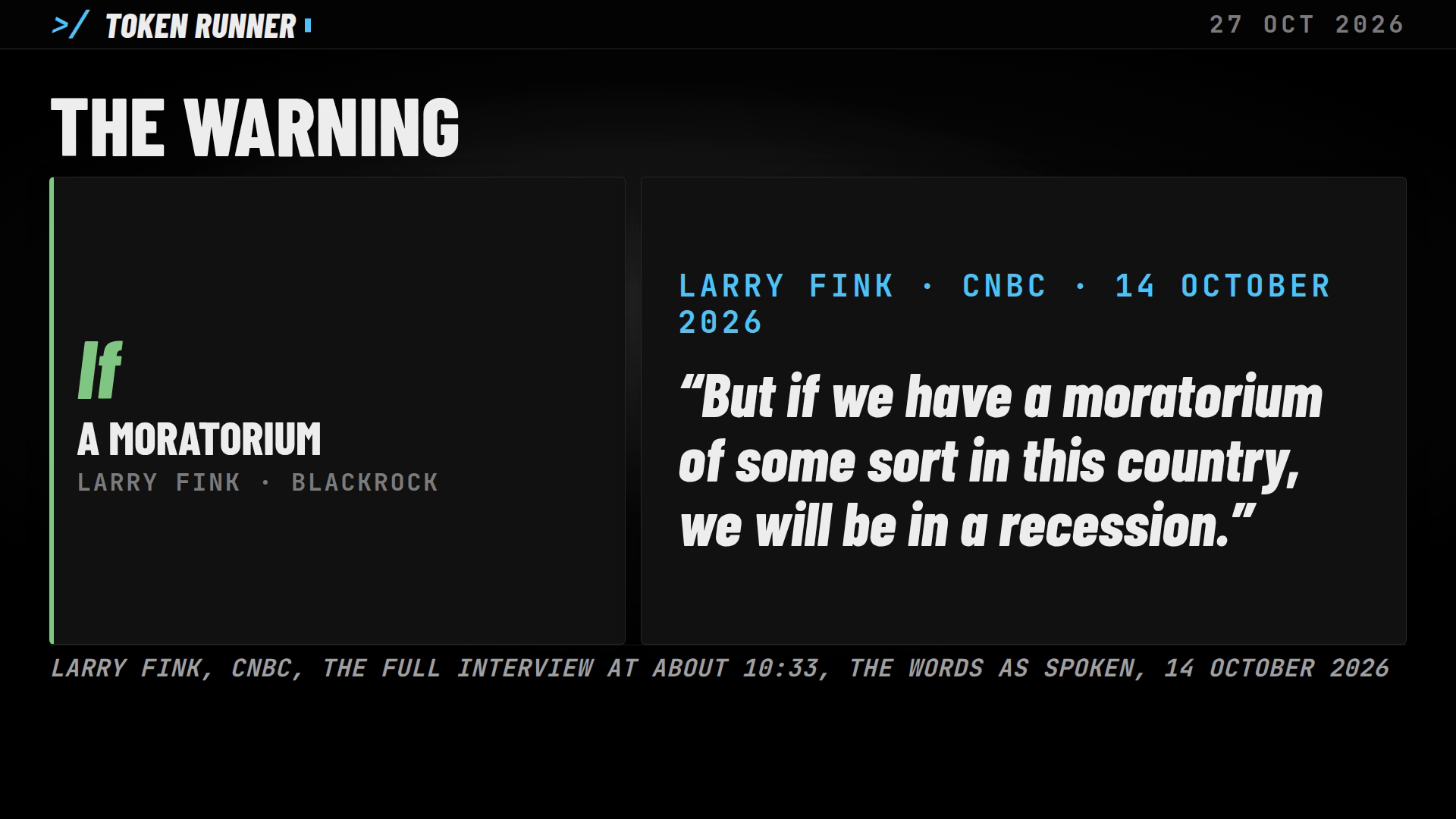
On the fourteenth of October, the head of the world's biggest money manager made a warning. Larry Fink, of BlackRock: "But if we have a moratorium of some sort in this country, we will be in a recession."
The warning
Larry Fink, who runs BlackRock, says a pause on data centres would put America in recession. Building them runs at about a quarter of one percent of the economy, as a spending rate, and his firm invests in them.
He said it on CNBC on 14 October 2026, at about 10:33 of the full interview (CNBC's own video), and CNBC's article of the same day reports the words. The warning is conditional, an if. This piece tests its size, not his honesty.
The if
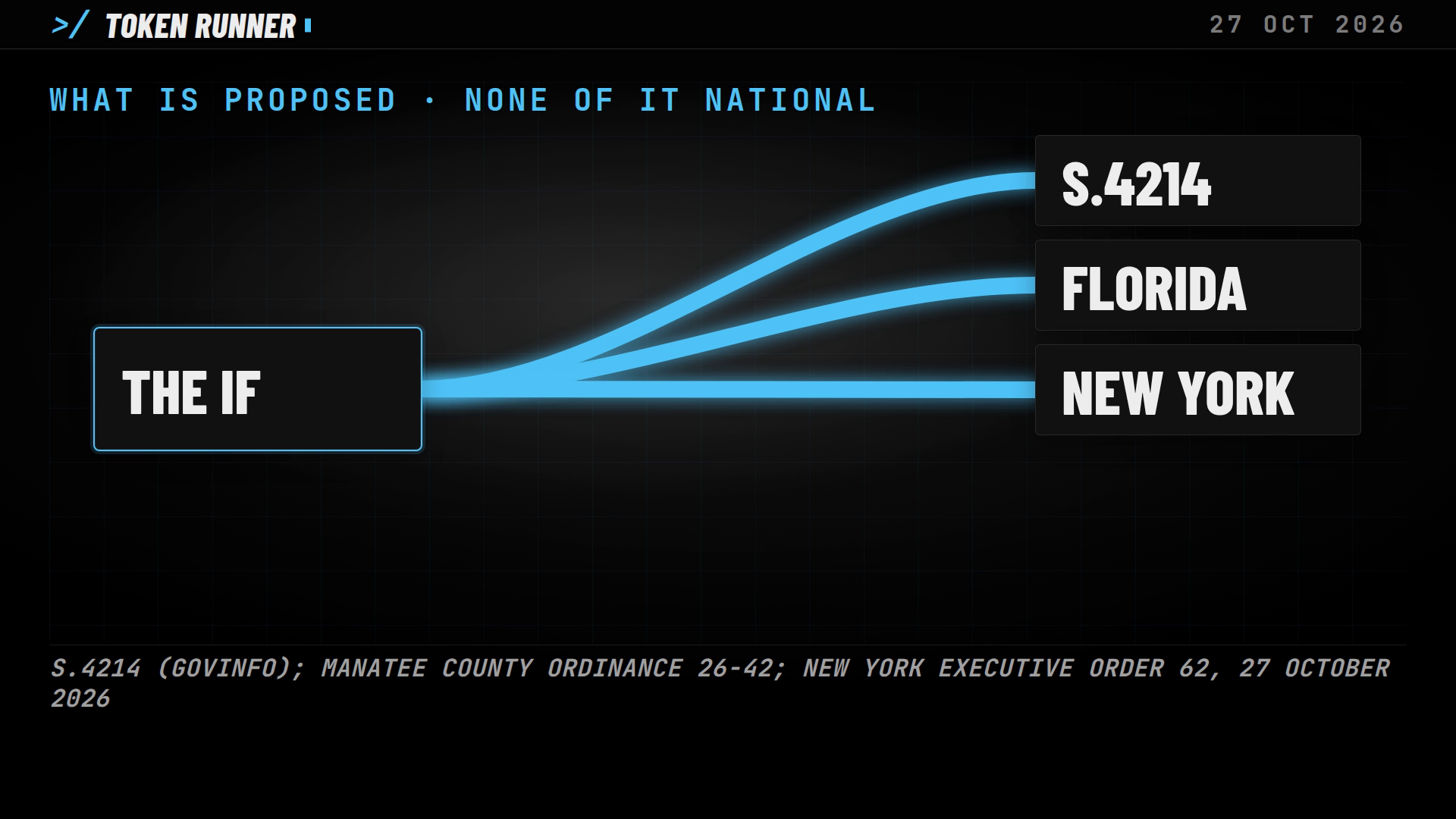
There is no national moratorium. A Senate bill was introduced in March and is not law. A county in Florida has paused new applications for a year, and New York has paused state environmental permits for the biggest sites. None of the three is national. So it is an if. How big is the if?
What is proposed, as of 27 October 2026: S.4214, introduced 25 March 2026 and referred to the Senate Committee on Commerce, Science, and Transportation, with a House bill, H.R. 9442, beside it; Manatee County, Florida, Ordinance 26-42 of 8 October 2026, a twelve-month pause on new data-centre applications in the unincorporated county; New York's Executive Order 62 of 14 July 2026, a pause on the state's environmental permits for data centres of 50 MW or more, with local permits untouched.
The buildings
The Census Bureau counts what America spends building data centres. In August 2026 it was running at about $85 billion a year. Two years earlier it was $36.7 billion. That is more than double in two years.
Source: U.S. Census Bureau, Construction Spending (C30), Value of Private Construction Put in Place, seasonally adjusted annual rate (privsatime.xlsx), the August 2026 release of 1 October 2026
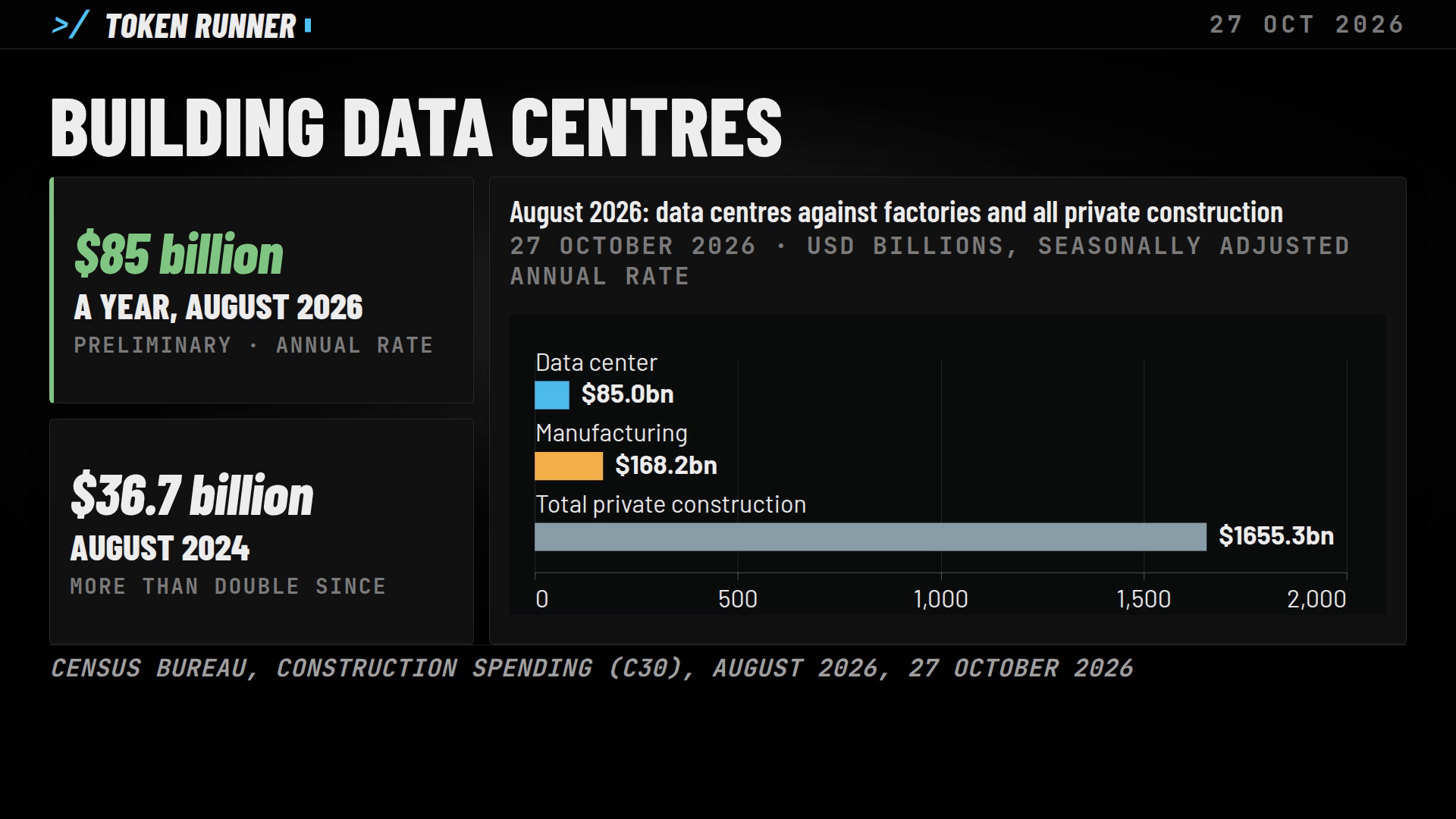
The Census Bureau's construction spending release of 1 October 2026: private data-centre construction at a seasonally adjusted annual rate of $84,950 million in August 2026 (preliminary; about $85 billion), $79,007 million in July (revised) and $36,668 million in August 2024 (about $36.7 billion). August against August is 2.32 times, our arithmetic. The count covers the buildings and their fit-out. The racks and servers inside are not in it.
The climb is recent. The Census monthly count starts in January 2014 at $1,637 million a year, 0.23 per cent of private construction. It reached $8,829 million in August 2019 and $36,668 million in August 2024. In 2026 every month has been higher than the one before: $56,211 million in January, $65,688 million in May, $84,950 million in August. Over the same eight months the share of private construction rose from 3.38 to 5.13 per cent.
Source: U.S. Census Bureau, Construction Spending (C30), Value of Private Construction Put in Place, seasonally adjusted annual rate (privsatime.xlsx), the August 2026 release of 1 October 2026
The scale
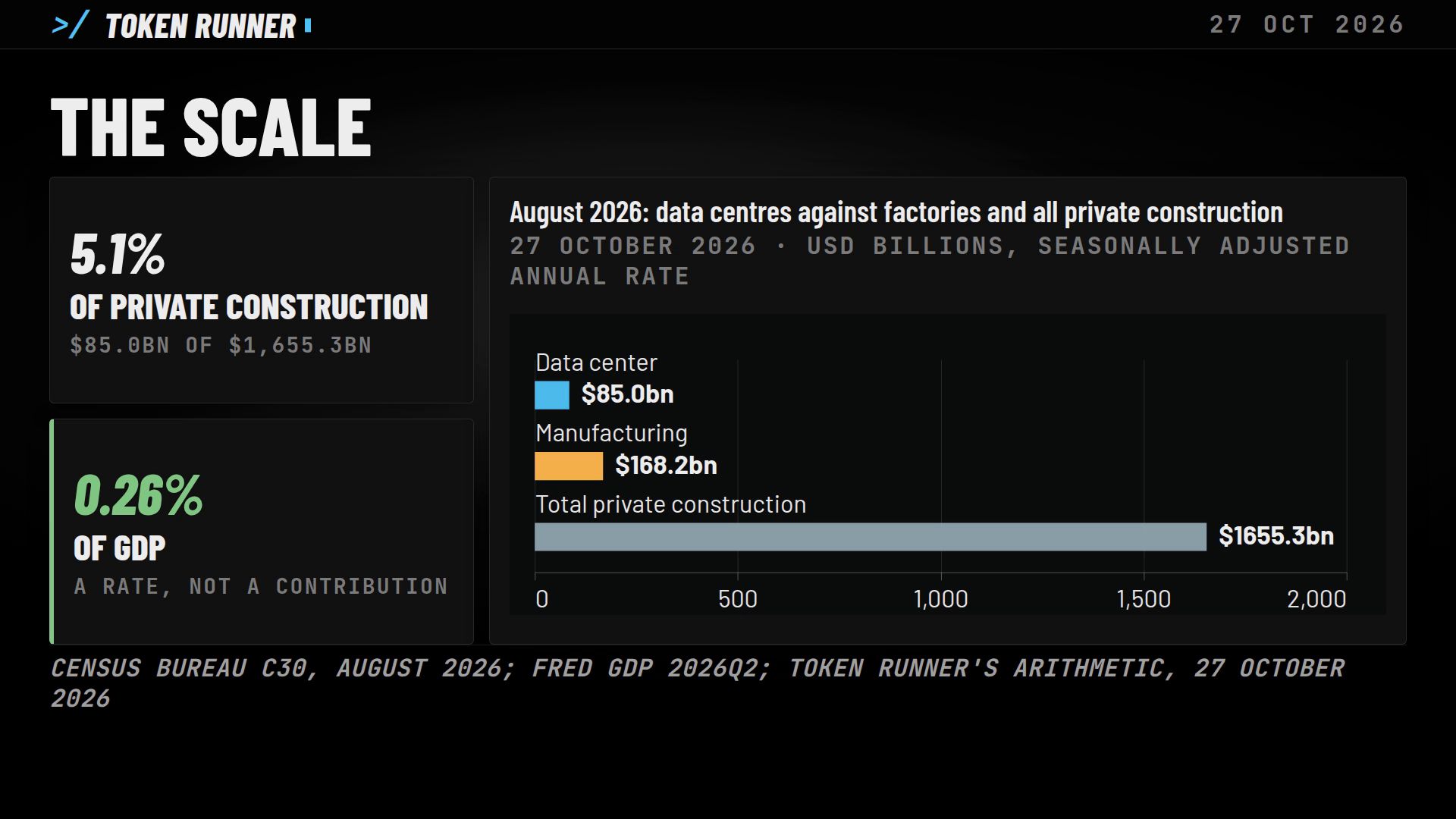
That is about five cents of every dollar spent on private construction. Factories still get about twice as much. Against the whole economy, building data centres runs at about a quarter of one percent.
In August 2026 data centres were 5.13 per cent (about 5.1%) of private construction: $84,950 million of $1,655,280 million. Manufacturing plants took $168,209 million, 1.98 times as much, our arithmetic. Against nominal GDP of $32,563 billion in the second quarter of 2026, $84,950 million a year is 0.26 per cent. That is a spending rate set against the size of the economy, not a contribution to its growth.
The growth
The government's growth figures say the same. For four quarters in a row, building of this kind took away from growth: offices, plants and data centres all together. The deepest was 0.31 points in the last quarter of 2025. What added to growth was spending on computers and software, across the whole economy.
Source: U.S. Bureau of Economic Analysis, National Income and Product Accounts, contributions to percent change in real GDP (FRED series A009RY2Q224SBEA, Y034RY2Q224SBEA, Y001RY2Q224SBEA), read at source 27 October 2026
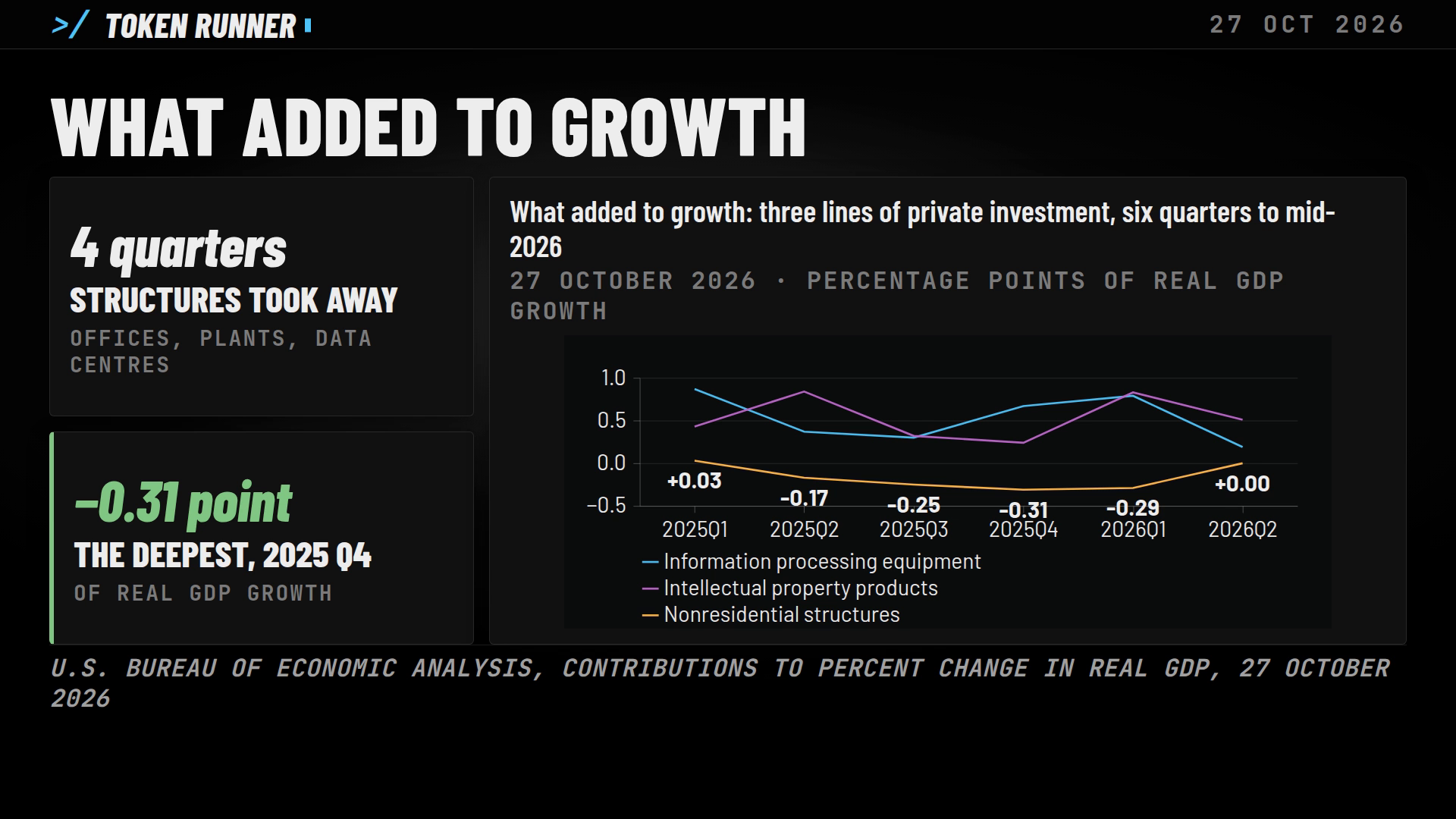
The Bureau of Economic Analysis's contributions to the change in real GDP, in percentage points: nonresidential structures, all of them, 0.03 in the first quarter of 2025, then -0.17, -0.25, -0.31 and -0.29 through the first quarter of 2026, and 0.00 in the second; information processing equipment 0.87, 0.37, 0.30, 0.67, 0.79 and 0.19; intellectual property products 0.43, 0.84, 0.32, 0.24, 0.83 and 0.51. The advance estimate for the third quarter is due on 29 October.
To be fair
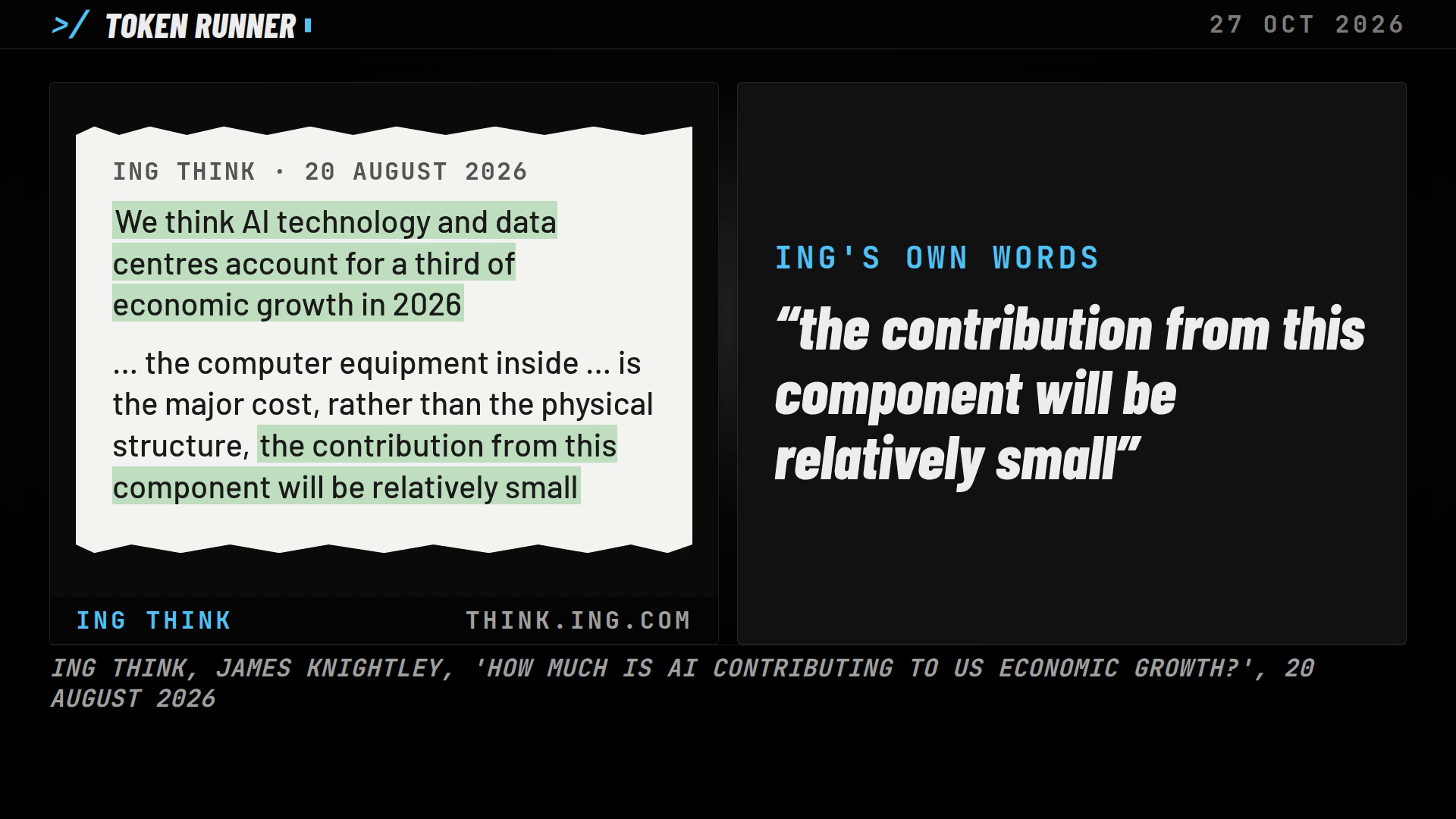
That is the strongest case for Fink. The bank ING says AI accounts for a third of US growth this year. But it says the buildings themselves contribute little, because the computers inside are the main cost. And, our point: no building means nowhere to put the computers.
ING, 20 August 2026: "We think AI technology and data centres account for a third of economic growth in 2026". On the structures: "given it is the computer equipment inside that is the major cost, rather than the physical structure, the contribution from this component will be relatively small".
BlackRock's interest
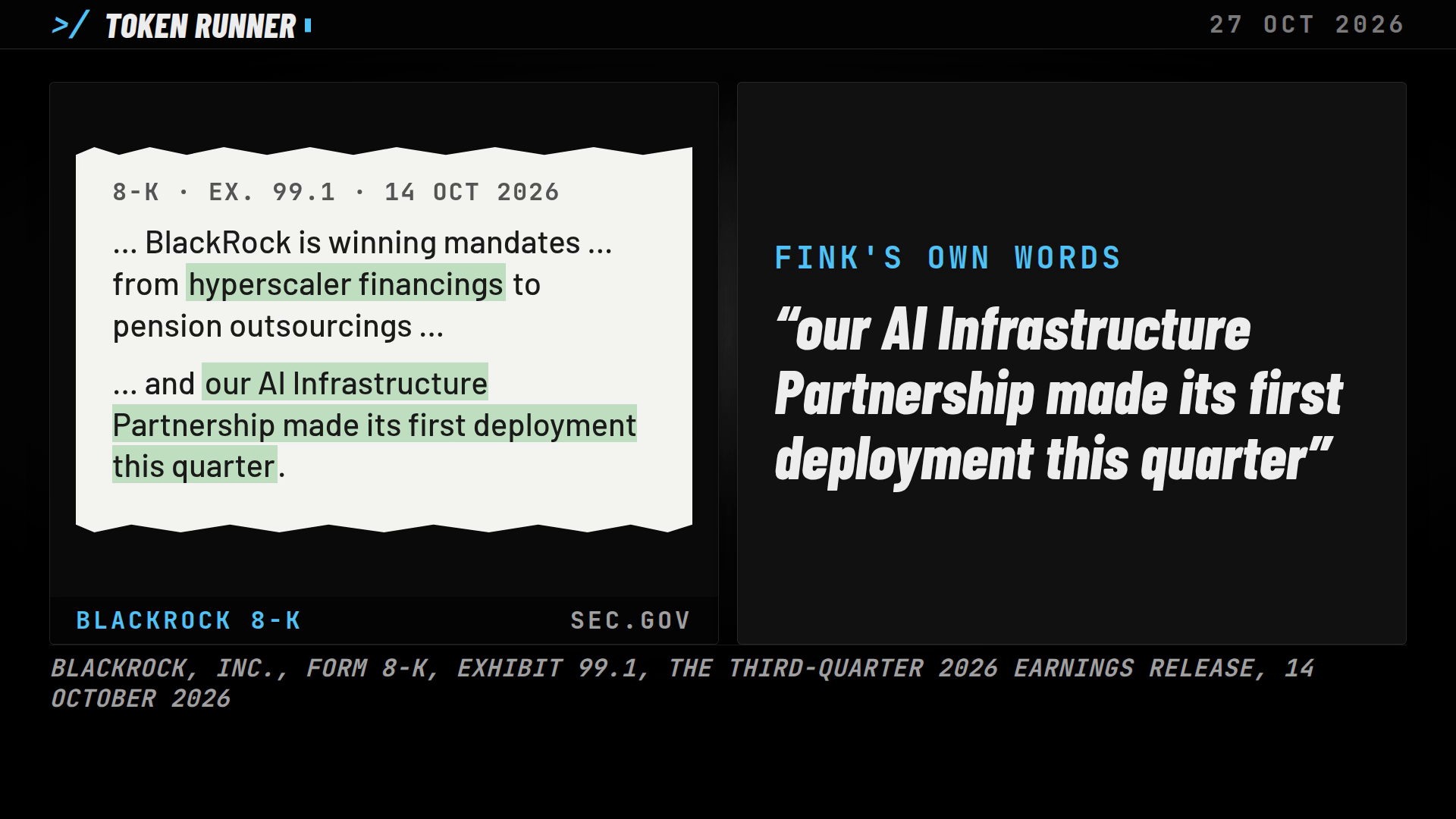
BlackRock's own 2025 letter, filed with the SEC, calls the firm "the largest asset manager in the world". One more thing, from Fink's own words in BlackRock's third-quarter earnings release. He says the firm is winning mandates in "hyperscaler financings", and its AI Infrastructure Partnership has made its first deployment.
BlackRock's exhibit 99.1 of 14 October 2026, in Fink's quoted statement: "It's why BlackRock is winning mandates at the cutting edge of capital markets, from hyperscaler financings to pension outsourcings to Aladdin and Preqin partnerships." And: "We've raised $68 billion in private markets over the last twelve months". The release files no figure for the firm's data-centre exposure, and none is given here.
Buildings or computers
A pause on building would hit a small slice of the economy.
A pause on the computers would hit a big share of growth. Fink's warning is biggest if the first becomes the second.
The dates to watch: the advance estimate of third-quarter growth on 29 October 2026, and the Census Bureau's September construction spending on 2 November 2026.
Every figure from the Census Bureau, the government's growth accounts, ING, and BlackRock's own filing.
Sources
- Larry Fink, chairman and chief executive of BlackRock, on CNBC, 14 October 2026, the full interview (14:20), at about 10:33, as spoken: "But if we have a moratorium of some sort in this country, we will be in a recession." (the audio checked by Token Runner; CNBC's page refuses Token Runner's own reader). BlackRock's 2025 letter, filed with the SEC, calls the firm "the largest asset manager in the world".
- U.S. Census Bureau, Construction Spending, August 2026 (CB26-158), released 1 October 2026: value of private construction put in place, seasonally adjusted annual rates (privsatime.xlsx), read at source by Token Runner on 27 October 2026: data centres $84,950 million (preliminary) in August 2026, $36,668 million in August 2024; manufacturing $168,209 million; total private construction $1,655,280 million. The Census definition excludes the racks and servers inside. Token Runner's own table of the Census count (CC BY 4.0).
- U.S. Bureau of Economic Analysis, contributions to percent change in real gross domestic product, via FRED, read at source on 27 October 2026: nonresidential structures (A009RY2Q224SBEA), information processing equipment (Y034RY2Q224SBEA), intellectual property products (Y001RY2Q224SBEA), 2024Q3 to 2026Q2 (the second estimate of 2026Q2; the 2026Q3 advance estimate is due 29 October 2026). Token Runner's own table of the three series.
- FRED, Gross Domestic Product (GDP), nominal, seasonally adjusted annual rate: $32,563.0 billion in 2026Q2, read at source on 27 October 2026. Token Runner's arithmetic: $84,950 million against it is 0.26 per cent, a spending rate set against GDP, not a contribution to growth.
- ING Think, James Knightley, "How much is AI contributing to US economic growth?", 20 August 2026, read at source on 27 October 2026: "We think AI technology and data centres account for a third of economic growth in 2026"; "given it is the computer equipment inside that is the major cost, rather than the physical structure, the contribution from this component will be relatively small".
- BlackRock, Inc., Form 8-K, exhibit 99.1 (the third-quarter 2026 earnings release), 14 October 2026, Fink's quoted statement, read at source on EDGAR on 27 October 2026: "It's why BlackRock is winning mandates at the cutting edge of capital markets, from hyperscaler financings to pension outsourcings to Aladdin and Preqin partnerships." and "We've raised $68 billion in private markets over the last twelve months, and our AI Infrastructure Partnership made its first deployment this quarter." The release files no figure for BlackRock's data-centre exposure.
- S.4214, 119th Congress, introduced 25 March 2026 and referred to the Committee on Commerce, Science, and Transportation (GovInfo; its status after 8 September 2026 could not be confirmed at congress.gov). Manatee County, Florida, Ordinance 26-42, 8 October 2026: new data-centre applications paused for twelve months in the unincorporated county. New York, Executive Order 62, 14 July 2026: the state's environmental (DEC) discretionary permits paused for data centres of 50 MW or more (read at source by Token Runner).
- Token Runner's own tables of the Census count and the three BEA series, each row from the release named in it, as a data file to download (CC BY 4.0).