Who paid for AI with people
WATCH THE FILM ON ITS OWN PAGE →
The robots didn't take the jobs. The bill for the robots did. Follow the money, not the press release. The biggest companies cut people in the same years they spent more on AI than any companies have ever spent on anything.
In short
Six companies wrote down that their cuts would pay for AI, about 5,800 jobs where they gave a count.
The biggest companies cut staff in the years their spending on AI soared, and Oracle's went from $21.2 billion to $55.7 billion in one year, while it borrowed $46.1 billion.
The companies selling the chips hired while their customers cut, with Micron adding about 8,000 staff and Nvidia about 6,000.
Who paid
The story we are usually told is that AI took the jobs. The machine learned the work, so the worker went. Our piece on what the companies say shows how little of the companies' own record supports that.
So we followed the money instead. Not what the machines did, but what the companies spent, what they borrowed, and what they wrote down about paying for it.
Here is what we found. The biggest companies cut people in the same years they spent more on data centres and chips than ever before. Six said in writing that the cut would pay for AI. The companies selling them the chips were hiring. It is less dramatic than the machine story, and better documented.
The money for AI had to come from somewhere. Some of it came from people.
Spending without precedent
The largest technology companies are spending on AI at a scale nobody has spent on anything. Their filings show it.
Oracle's capital spending, the money it puts into data centres, chips and buildings, went from $21.2 billion to $55.7 billion in a single fiscal year. That is more than two and a half times as much. Amazon spent $131.8 billion on property and equipment in 2025. Microsoft spent about $115.9 billion in the four quarters to June 2026.
In the same filings, or the ones beside them, those companies cut staff.
Source: Layoffs.fyi's AI-attributed list, as listed (jobs gone, REPORTED), with the research join of 28 October 2026 and the relabel of 29 October 2026 (the jobs figure tested against the company's own filing or post); SEC XBRL companyfacts, each company's 10-Q and 10-K (capital spending, FACT)
Source: Layoffs.fyi's AI-attributed list, as listed (jobs gone, REPORTED), with the research join of 28 October 2026 and the relabel of 29 October 2026 (the jobs figure tested against the company's own filing or post); SEC XBRL companyfacts, each company's 10-Q and 10-K (capital spending, FACT)
Source: Layoffs.fyi's AI-attributed list, as listed (jobs gone, REPORTED), with the research join of 28 October 2026 and the relabel of 29 October 2026 (the jobs figure tested against the company's own filing or post); SEC XBRL companyfacts, each company's 10-Q and 10-K (capital spending, FACT)
Six who wrote it down
Six companies said it in a filing to the securities regulator, the document they are legally answerable for. The cut would pay for AI. They were Workday, Autodesk, Pinterest, Atlassian, Groupon and Rackspace.
Together that is about 5,800 jobs, where the companies gave a count. Rackspace gave none. Groupon put it most plainly: it cut "up to 400" to "rebuild the company as an AI-native company." Our piece on what the companies say reads all six filings, word by word.
This is the clearest link between AI and job cuts anywhere in the public record. It is not AI doing the work. It is AI being paid for.
Source: Layoffs.fyi's AI-attributed list and its whole list by month, theirs; company names from SEC EDGAR; a hand read of the companies' own words on 28 October 2026; the research join of 28 October 2026 (filings, company pages, WARN notices and press, every value cited); the relabel of 29 October 2026 (filings, company posts and state WARN sheets opened by hand)
Where the money came from
Oracle has said why, in a filing. In February 2026 it told investors it was raising money "to meet the contracted demand from our largest Oracle Cloud Infrastructure customers", naming OpenAI among them, and expected to raise $45 to $50 billion in 2026, half of it in debt. Oracle borrowed $46.1 billion in fiscal 2026, the most in any year our record holds. That is by its own cash-flow statement, the page of its annual report that shows where its cash came from. The year before, it borrowed $19.5 billion. Two years before, it borrowed nothing on that line.
This autumn Oracle cut 800 people at four sites. We know that from the layoff notices states require, not from Oracle, which gave no number of its own.
Amazon, by contrast, raised nothing from long-term debt in 2023 or 2024.
Meta's chief executive, telling staff in April 2026 why the company would cut, pointed to capital spending. He said "we do need to take down the size of the company somewhat," as Reuters, which was in the room, reported it. The company's framing was the cost of the build, not the machines taking the work.
A dollar saved on salaries is a dollar for chips. At these sums, the salaries are small. But they are the cost a company can cut fastest.
Spending on that scale is paid for three ways: from profits, from borrowing and from savings. The filings show all three.
Source: SEC XBRL companyfacts: each company's annual 10-K (capital spending and revenue by calendar year) and its 10-Q and 10-K cash-flow lines (debt raised by fiscal year); the cutters are the companies of Layoffs.fyi's AI-attributed list with a cut of 1,000 or more
Source: SEC XBRL companyfacts: each company's annual 10-K (capital spending and revenue by calendar year) and its 10-Q and 10-K cash-flow lines (debt raised by fiscal year); the cutters are the companies of Layoffs.fyi's AI-attributed list with a cut of 1,000 or more
The number you read is rarely a count
There is a second problem with the big numbers. Many of them are not counts of people.
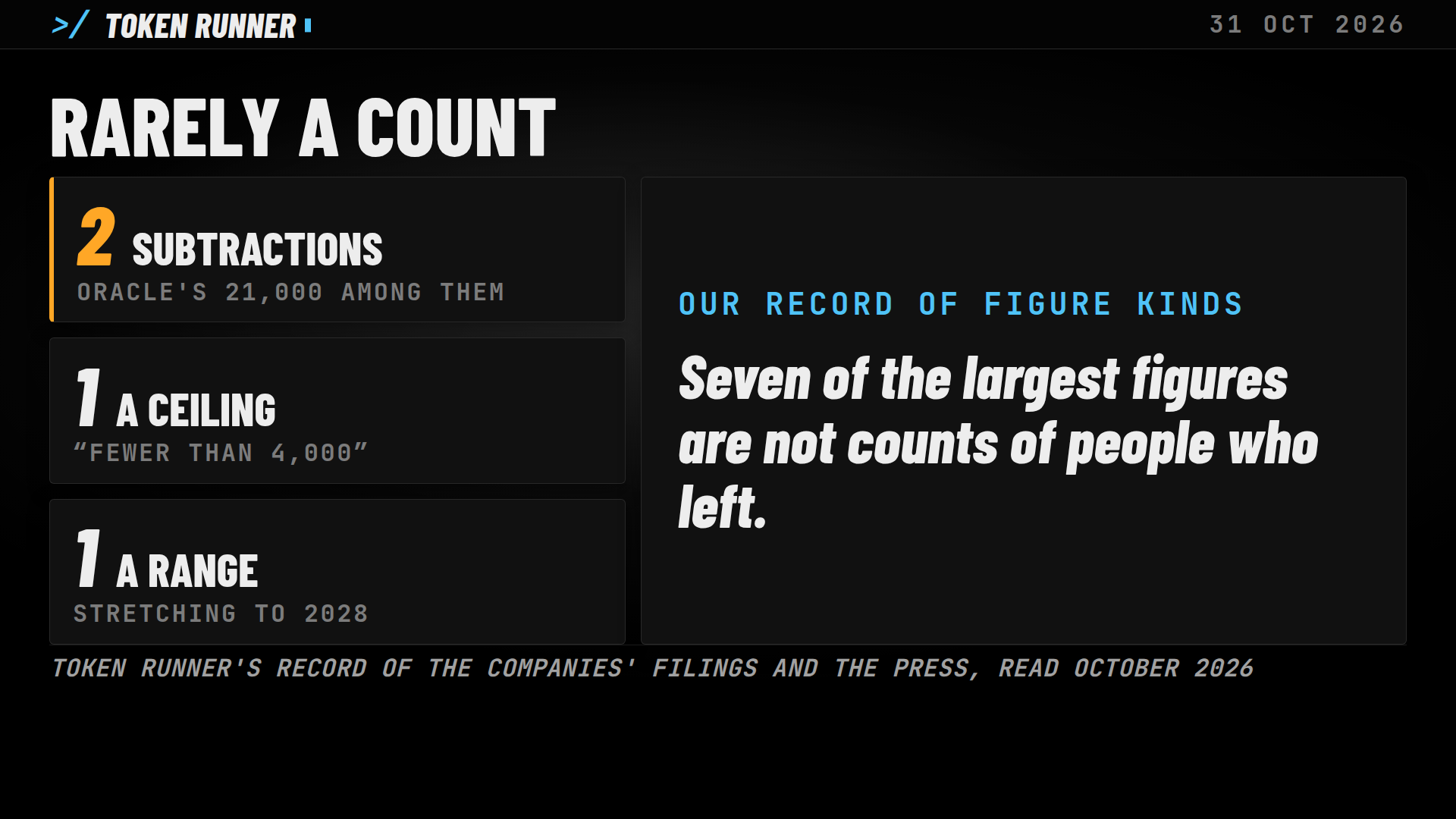
Of the largest layoff figures in our own record, seven are not counts of people who left. Two are subtractions: one year's headcount minus another's, which mixes leavers with hires and transfers. Oracle is one of them: its headcount fell by about 21,000, net, by the company's year-end counts. One is a ceiling, "fewer than 4,000." One is a range stretching to 2028. Two are percentages turned into numbers by someone else. One is a remark.
Microsoft's widely quoted 60,000 is, as reported, the number of people eligible for a buyout. It is not a number who were offered one, or who took one. Microsoft's own announcement of 26 October 2026 gives no number and no terms.
So when you read that a company cut tens of thousands of jobs for AI, two things are often not what they seem. The number is often not a count. And the reason is often not the company's.
The sellers added staff
If AI were simply replacing workers, the companies at the heart of it would be cutting fastest. Instead the money flowed to them, and they hired.
One more thing in the filings fits the money story, not the machine story. The companies selling the chips and the equipment hired while their customers cut. Micron added about 8,000 staff, Nvidia about 6,000, and Lam Research about 4,300. Their accounting years end at different times, so the periods do not line up exactly.
Source: The companies' own 10-K filings (Item 1, Human Capital): the employee counts with accession numbers, as the research pass of 28 October 2026 quoted them, and the hand record of 29 October 2026 (Oracle's two 10-Ks, Meta's 8-K, Microsoft's two 10-Ks and Amazon's two 10-Ks, opened on 29 October 2026); company names from SEC EDGAR
The trackers' tag
The layoff tracker most often quoted tags about a third of everyone laid off since January 2024 as AI-related: 138,781 of 411,441 people over 34 months. That tag is the tracker's own coding, not what the companies said, as our piece on what the companies say sets out. For this story, its flaw is simpler. It does not separate the cut that paid for AI from the job AI did.
Source: Layoffs.fyi, the AI layoffs list and its monthly totals (https://layoffs.fyi/ai-layoffs/)
Source: Layoffs.fyi, the AI layoffs list and its monthly totals (https://layoffs.fyi/ai-layoffs/)
Why it matters
"AI took my job" and "my job paid for AI" sound alike. They are different stories, with different answers. The evidence supports two readings of how far the second one goes.
The first is the money story, taken whole. The cuts helped fund the build. Then the questions are not about retraining, or which jobs the machines take next. They are about the build itself. Who is borrowing, and how much? What happens to the people, the towns and the power grid if the spending stops? And who decides that the salaries go first?
The second is more cautious. Only six companies wrote the link down. Everywhere else, the cuts and the spending sit side by side in the same filings, and that is not proof that one paid for the other. At these sums, the salaries are small. A company can cut people for many reasons in a year it also builds.
Either way, the companies' filings answer the questions about the build far better than the questions about the machine. That is where we will keep looking.
Our ask is simple. When you read that AI took the jobs, ask where the money went, and who paid for it.
Sources
- The companies' SEC filings by accession, including Oracle's 10-K, accession 0001193125-26-277521, and the six filings named in the chart
- Amazon's and Microsoft's filings for capital spending
- The 10-Ks of Micron, Nvidia and Lam Research
- Oracle's state layoff notices
- Reuters via a syndicated copy for Meta
- Microsoft's post of 26 October 2026, and the reports via ITPro, CNBC, GeekWire and Reuters sources for the 60,000
- Our own record of what kind of figure each is
- Layoffs.fyi's counts, as a monthly table
- Token Runner is built with Claude, which is made by Anthropic.