Beijing's Turn
Since 2022, America has controlled which AI chips can go to China. This month, China published its answer.
The proposal
America has controlled which AI chips reach China since 2022. Now China proposes to control the models: the biggest AI models, advanced agents and chip designs would need a licence to leave the country, while serving them abroad by API would stay outside the controls.
On 16 October China's commerce and science ministries proposed adding 40 technologies to the list it bans or restricts from export. Twenty-three are in AI.
Source: MOFCOM and MOST, Announcement 2026 No. 48 (16 October 2026), its Annex 1 and the MOFCOM spokesperson's Q&A of the same day, read at source 28 October 2026
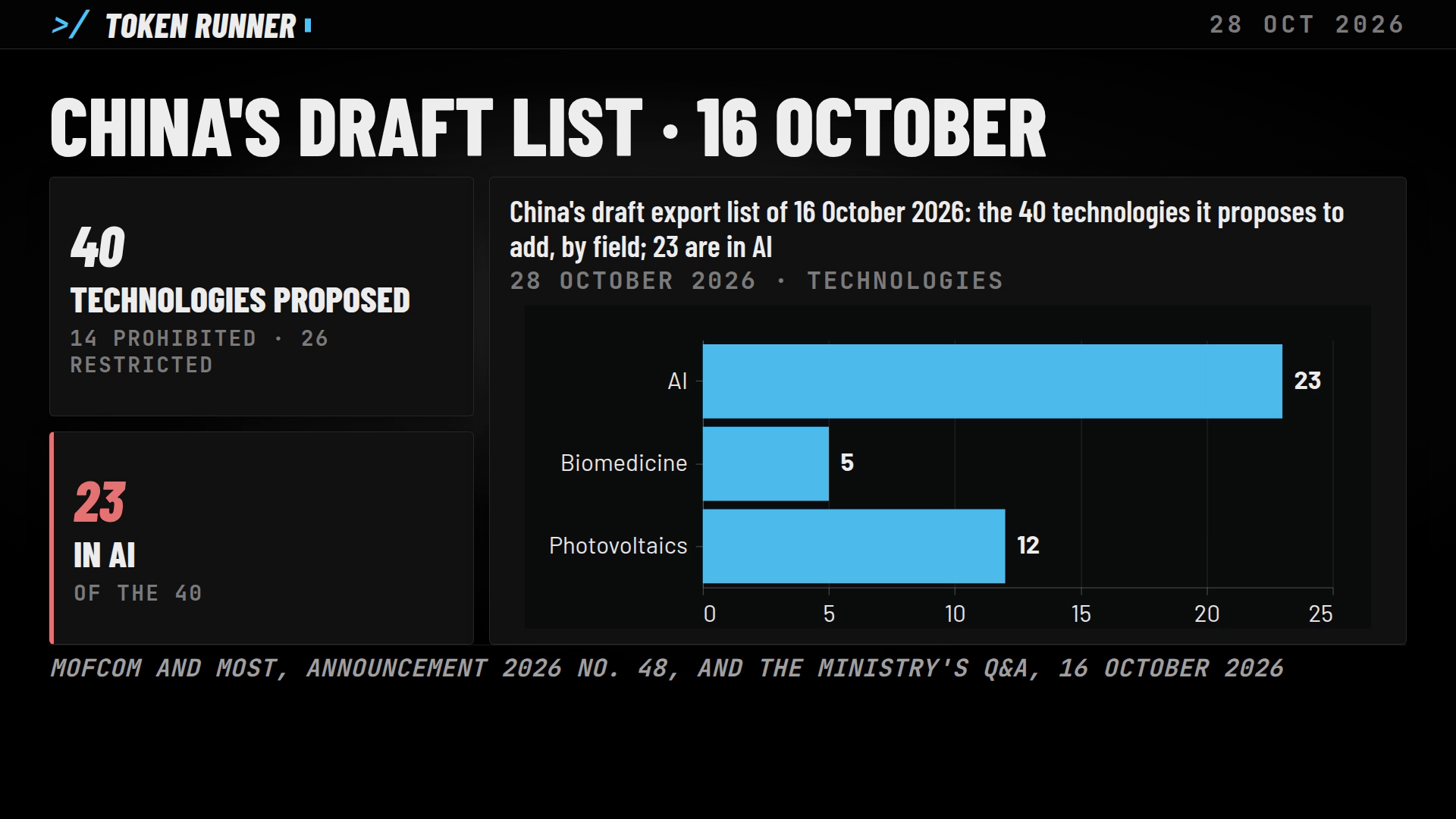
Fourteen of the 40 would be prohibited outright, and 26 restricted, needing a licence. The rest of the list covers photovoltaics, with 12, and biomedicine, with 5.
MOFCOM and MOST, Announcement 2026 No. 48, 16 October 2026: a draft revision of the Catalogue of Technologies Prohibited or Restricted from Export. The prohibited and restricted counts are the ministry's Q&A. The US rule on advanced chips for China took effect on 7 October 2022.
The line
The biggest models would be restricted. The line is training with at least 10²⁶ operations, at least 2 trillion parameters, or a place in the world's top ten on public evaluations at the time of export.
Advanced agents, AI chip designs and the technology behind clusters of more than 10,000 chips would be restricted too.
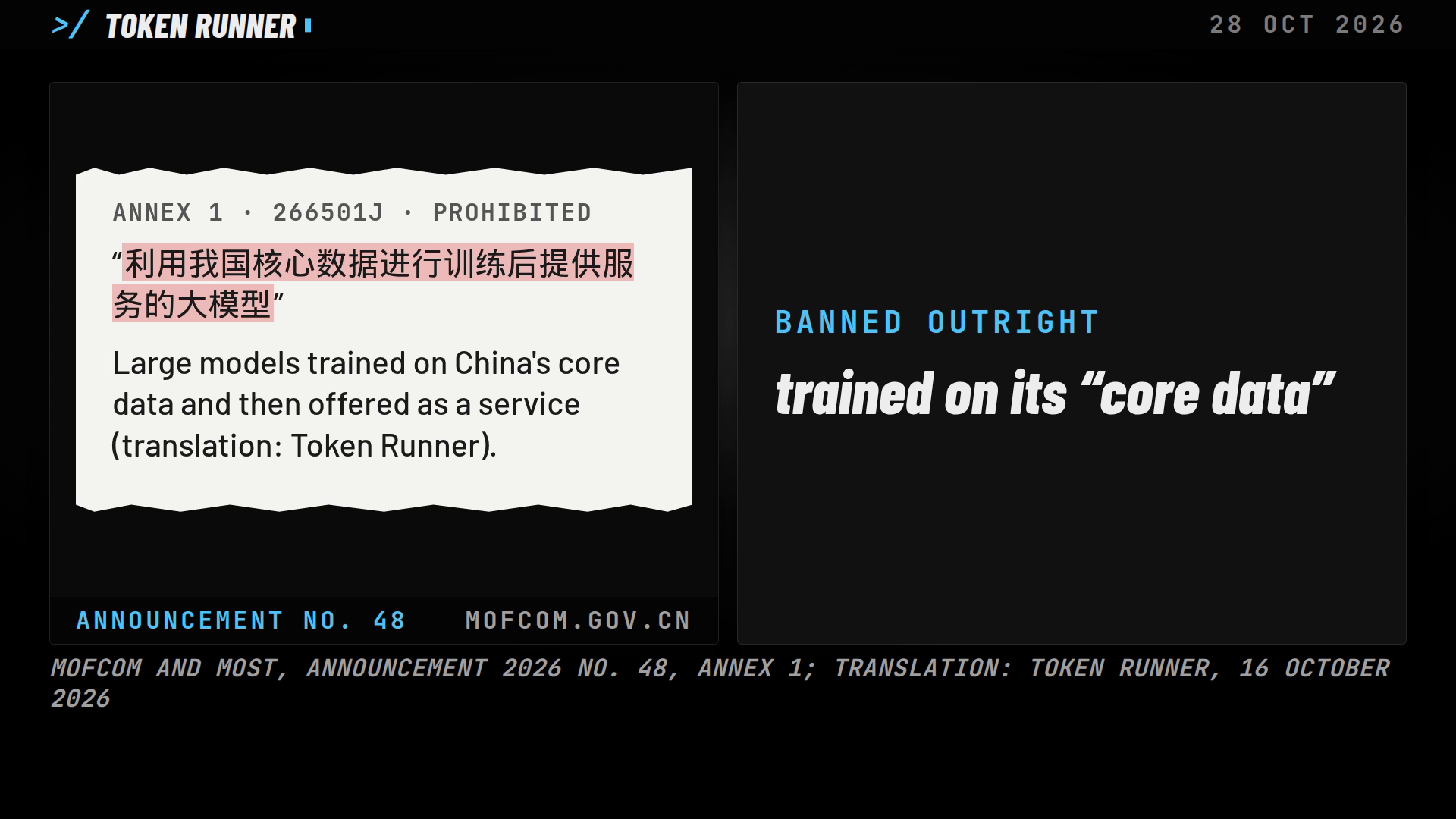
Models trained on what China calls its "core data" and then offered as a service would be banned outright.
Annex 1 of the draft, item by item. Restricted, 266504X, the biggest models: trained with at least 10^26 operations, or at least 2 trillion parameters, or with capability "达到全球领先水平", which the annex's note defines as the global top 10 on mainstream public evaluations at the time of export. Restricted, 266505X: advanced agents (at least 20-step task decomposition, at least 60 agents working at once, at least 200 tools). Restricted, 266506X: AI chip design at 14 nm or below, and advanced packaging. Restricted, 266507X: the technology of clusters of more than 10,000 accelerator cards. Prohibited, 266501J: large models trained on China's core data and then offered as a service.
What stays free
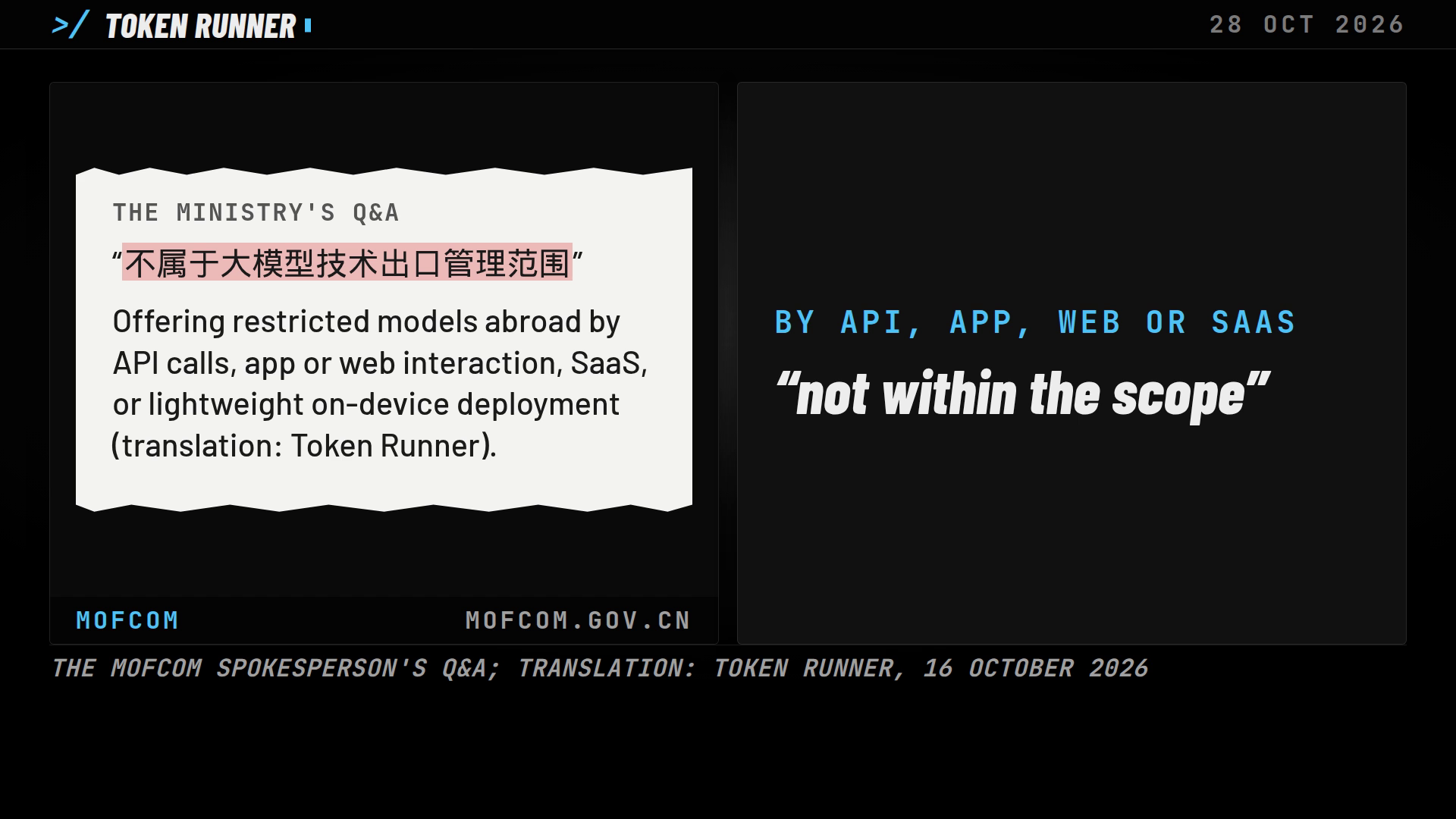
Serving the models abroad stays open. In the ministry's words, offering them by API, app, web or SaaS is "not within the scope" of the controls.
Technology already public through open source or published papers is out of scope too. New open-source releases are not exempt; the ministry lists them among the cases for automatic licensing.
The Q&A: "对于企业利用限制类大模型对外提供API调用、APP/网页交互、SaaS应用、本地端侧轻量化部署等情形,不属于大模型技术出口管理范围。" Translation (Token Runner): where companies use restricted large models to provide API calls, app or web interaction, SaaS applications or lightweight on-device deployment abroad, this is not within the scope of large-model technology export control. Deploying a restricted model locally overseas is within scope; on a company's own overseas cloud it can get facilitation such as automatic licensing. The announcement: "对已通过开源、发表学术论文等方式进入公共领域的技术,不纳入管理范围": technology already in the public domain through open source or published papers is outside the scope (translation: Token Runner).
The ministry's words
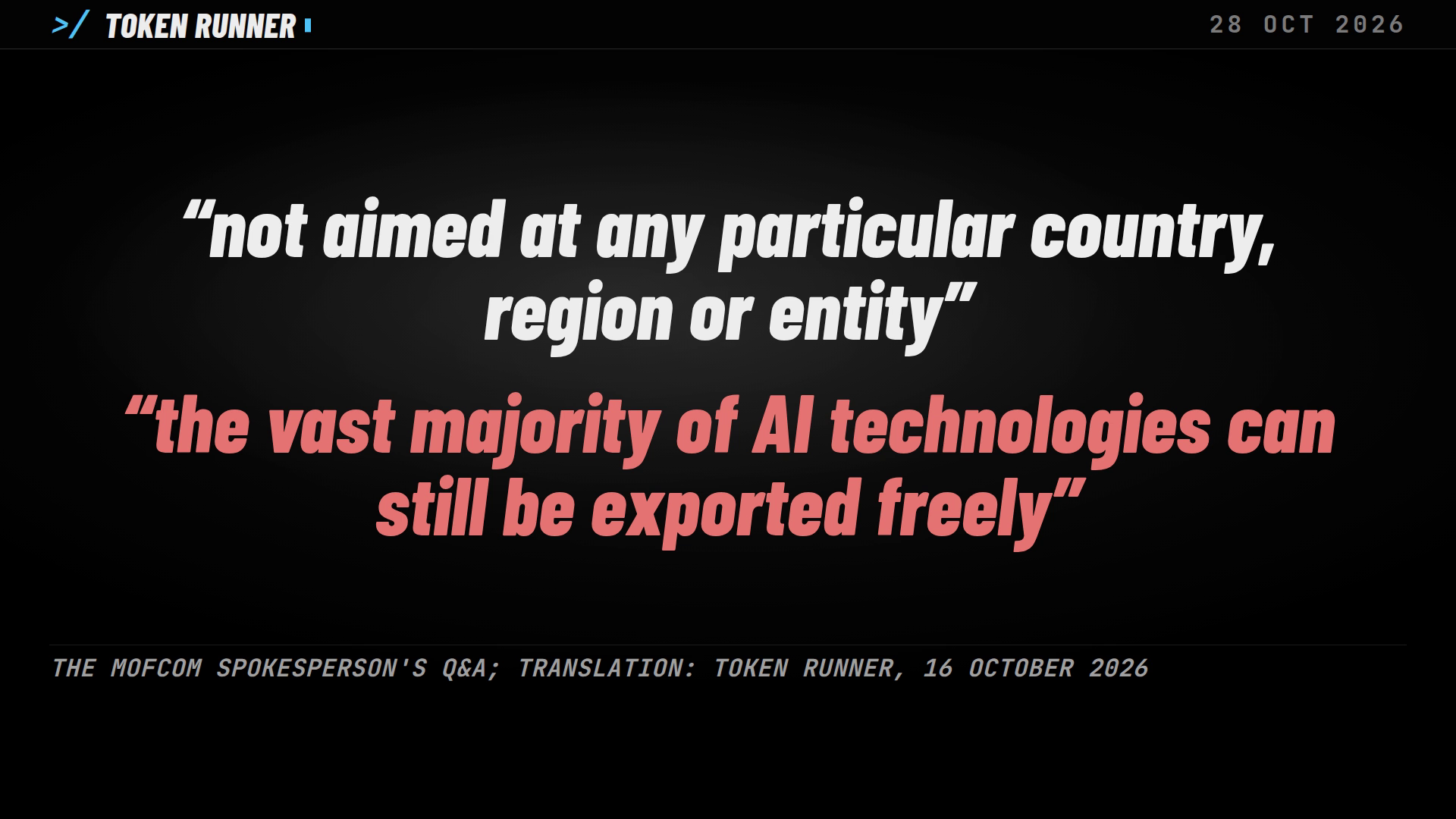
The ministry calls the revision routine and "not aimed at any particular country, region or entity". Once the measures take effect, it says, "the vast majority of AI technologies can still be exported freely".
Reuters read the API carve-out as a way for Chinese developers such as DeepSeek and Alibaba to keep expanding abroad under closer watch from Beijing. We found no US government reaction at a primary source.
The spokesperson: "不针对任何特定国家、地区或实体" and "绝大部分人工智能技术仍可以自由出口" (translations: Token Runner). Reuters, 16 October: the carve-out "could allow Chinese AI developers such as DeepSeek and Alibaba to continue expanding internationally while giving Beijing greater oversight".
Already in force
The list is still a draft, open for comment until 15 November. One duty already applies. Since the day of publication, 16 October, a company must register before exporting any technology on the list.
Registration is not a licence. No amended draft or final catalogue had been published when we read the ministry's pages on 28 October.
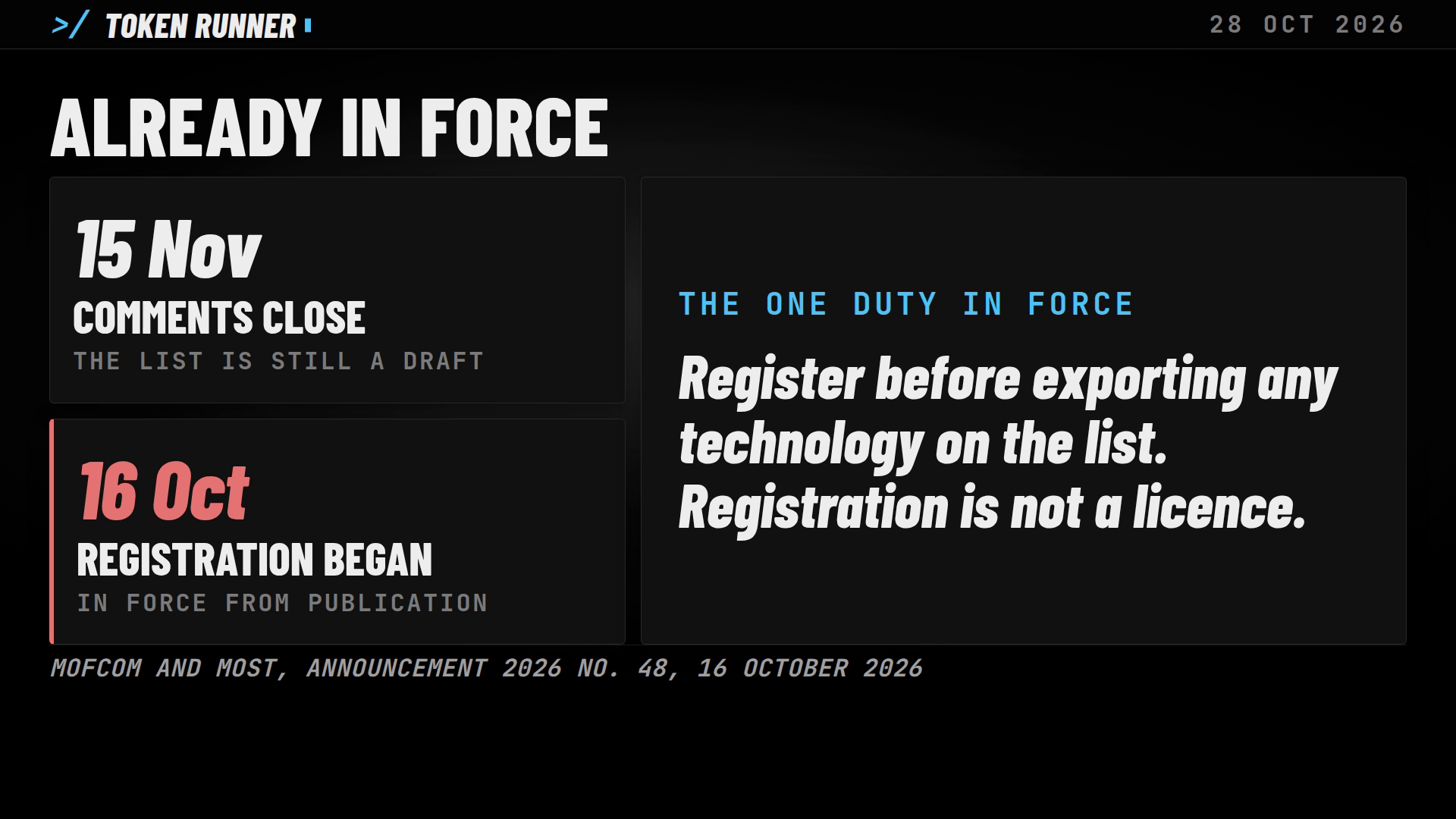
The announcement: "自本公告发布之日起", from the day of publication until the catalogue is formally revised and in force, exporters must register on the ministry's technology trade system before exporting a listed technology (translation: Token Runner). Comments are open from 16 October to 15 November 2026.
The first registration
One company has already said it registered. On 23 October MiniMax told the Hong Kong stock exchange it had completed the registration under Announcement No. 48, for the open-source release and overseas licensing of some of its models.
That is the company's own statement, in its announcement to the exchange. The ministry names no company, and neither do we for the list itself.
The know-how
Washington controls the hardware. Beijing proposes to control the know-how, and leave the service open.
Two things to watch. Whether the final list keeps the API carve-out after comments close on 15 November. And which companies register next.
What we couldn't confirm: which companies' models the list would catch.
Every word from China's own announcement and its ministry. Token Runner dot A I.
Sources
- MOFCOM and MOST, Announcement 2026 No. 48 (商务部 科技部公告2026年第48号), 16 October 2026, with Annex 1, the draft list: 40 technologies in AI, biomedicine and photovoltaics; comments 16 October to 15 November 2026; registration before export from the day of publication.
- The MOFCOM spokesperson's Q&A, 16 October 2026: 14 prohibited and 26 restricted; the API, app, web and SaaS uses "不属于大模型技术出口管理范围"; "不针对任何特定国家、地区或实体"; "绝大部分人工智能技术仍可以自由出口".
- MiniMax, announcement to the Hong Kong stock exchange, 23 October 2026: registration completed under Announcement No. 48.
- US Department of Commerce, Bureau of Industry and Security, interim final rule on advanced computing and semiconductor items, 87 FR 62186, published 13 October 2022, effective 7 October 2022.
- Reuters, 16 October 2026, 'Beijing seeks tighter grip on AI exports amid US rivalry', as carried by StreetInsider.