Who Gets the Power Plant
The biggest grid in America keeps the lights on for more than sixty-seven million people, from Chicago to Washington. Its capacity price went from under $30 to the cap, and its own monitor puts $6.3 billion of this year's charges on data-centre load.
Every year, it holds an auction to buy enough power for the years ahead.
The auction
For the year starting in 2024, the price was under thirty dollars per megawatt per day. In the next auction, it jumped to nearly two hundred and seventy. Since then, it has sat at the ceiling regulators approved: about three hundred and thirty.
PJM's own auction reports, in dollars per megawatt-day: $28.92 for 2024/25, an auction finalised in February 2023, and $269.92 for 2025/26. Then the cap: $329.17, $333.44 and $325, a 2.5% fall.
The cap is the FERC-approved price collar, set by PJM with the governors.
Source: PJM Interconnection, Base Residual Auction reports (2024/25 to 2028/29), read at source 28 October 2026
The shortfall
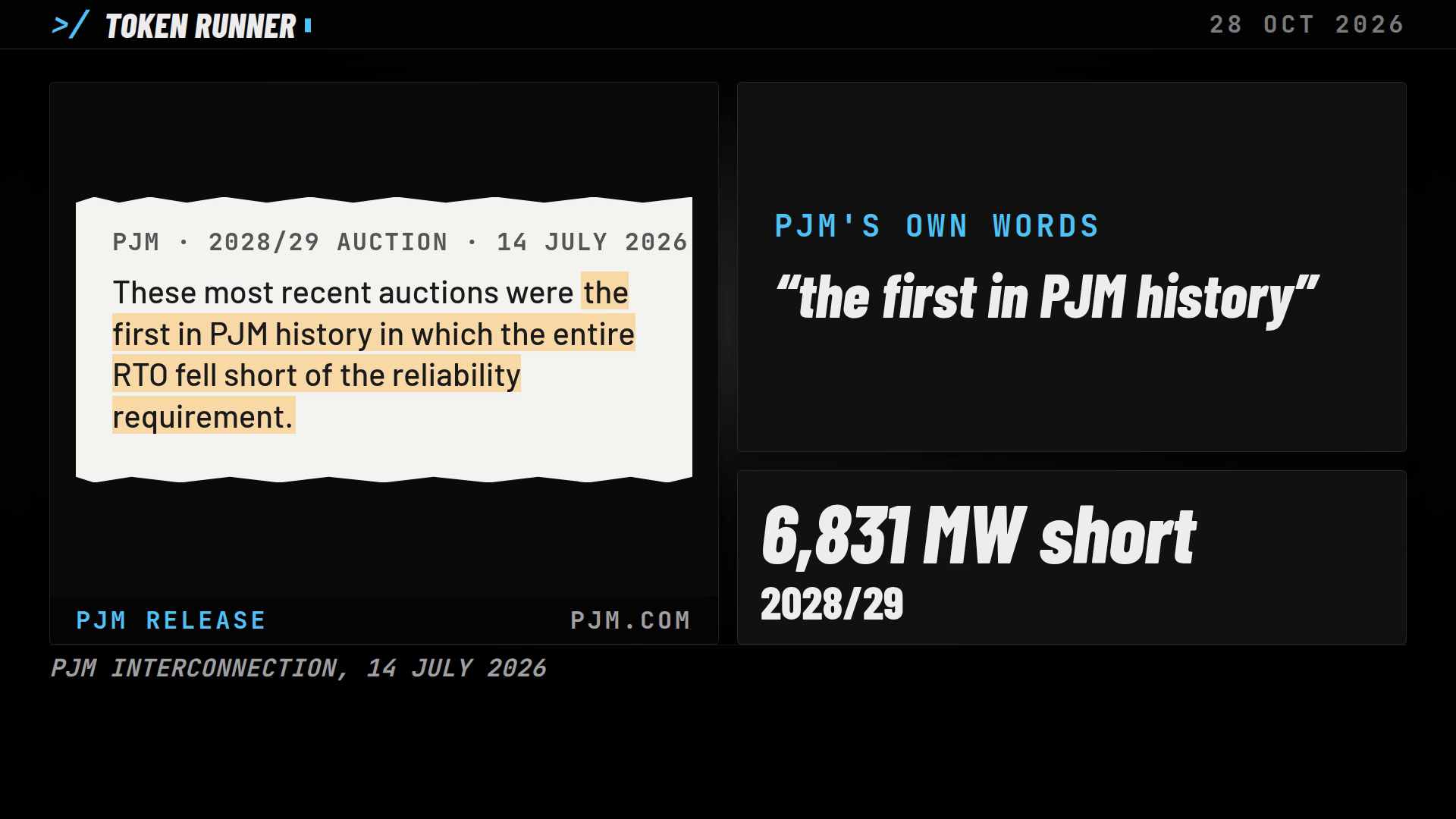
And in the last two auctions, the grid still couldn't buy enough to meet its own reliability requirement. The first time in its history.
PJM said so on 14 July 2026: "These most recent auctions were the first in PJM history in which the entire RTO fell short of the reliability requirement."
The auction for 2027/28 fell 6,517 MW short. The one for 2028/29 fell 6,831 MW short. The 2026/27 auction had cleared 139 MW above the requirement. The capacity total is not the cost to households: PJM says so.
The monitor's estimate
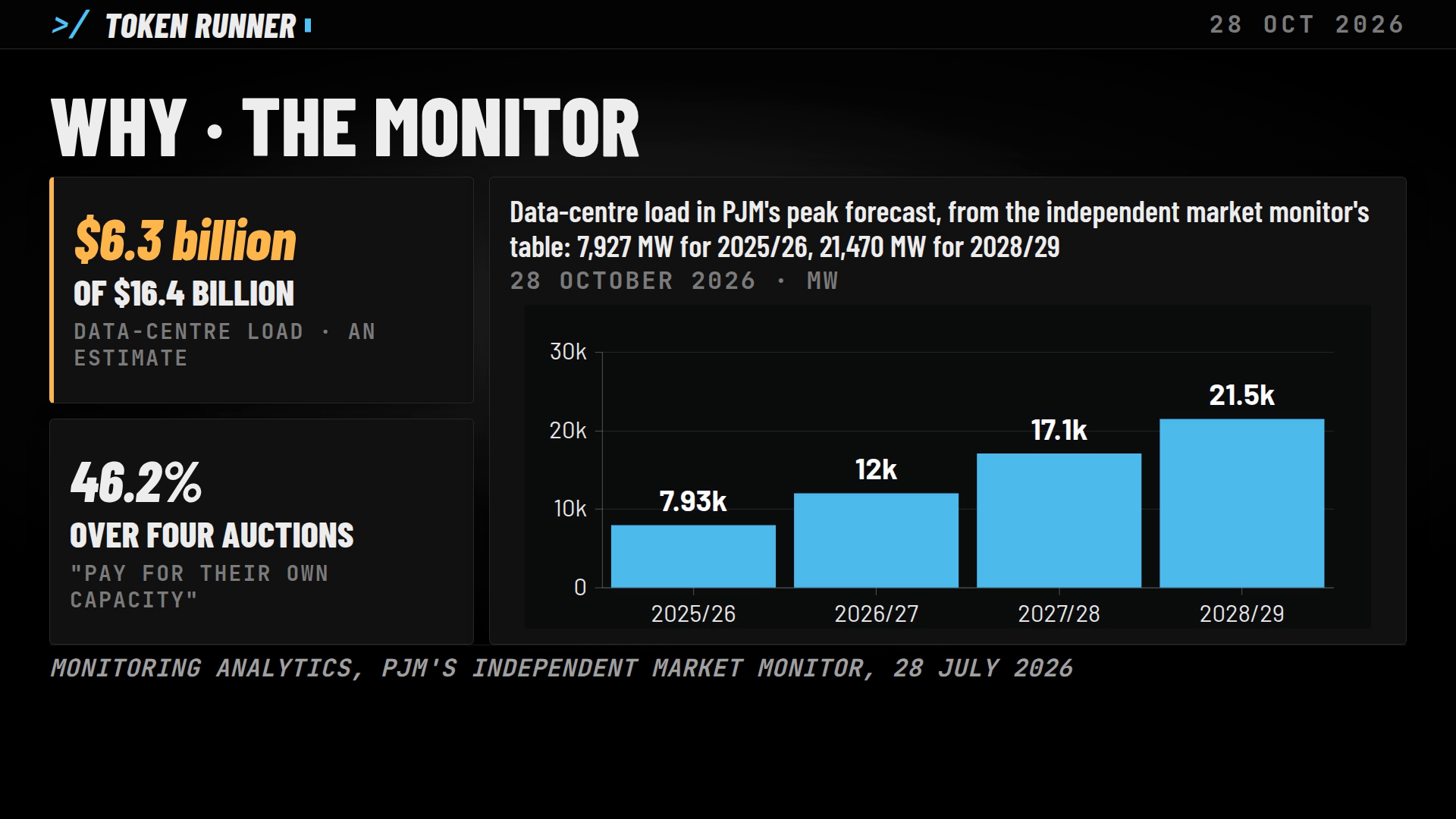
Its independent market monitor puts it plainly. Of this year's $16.4 billion in capacity charges, it estimates $6.3 billion "was a result of data center load". Over its last four auctions: nearly half.
Monitoring Analytics, on 28 July 2026: "of the $16.4B in capacity market charges, $6.3B was a result of data center load. This was 38.2 percent of the capacity market charges." And: "$29.4B, or 46.2 percent of total capacity market charges over those four auctions".
Its own table puts data-centre load in PJM's peak forecast at 7,927 MW for 2025/26, then 11,993 and 17,071, and 21,470 MW for 2028/29. Its proposal: make data centres "pay for their own capacity".
These are estimates, and the monitor says so. PJM disputes the cost reading: "The total value does not equate to the total cost to load". New generation that cleared: 2,669 MW UCAP in 2026/27, and 524.7 MW in 2028/29.
Source: Monitoring Analytics, PJM's independent market monitor, its report of 28 July 2026, read at source 28 October 2026
Texas
In Texas, the requests to connect add up to more than five times the state's record demand. About ninety percent are data centres. In August, the governor ordered an audit of every one "before any additional data centers are approved to move forward."
His letter of 3 August 2026: "ERCOT is currently considering approximately 474 gigawatts of requests to connect to the Texas grid. That is more than five times Texas' record peak electricity demand for ERCOT. Approximately 90 percent of the new power requests are data centers."
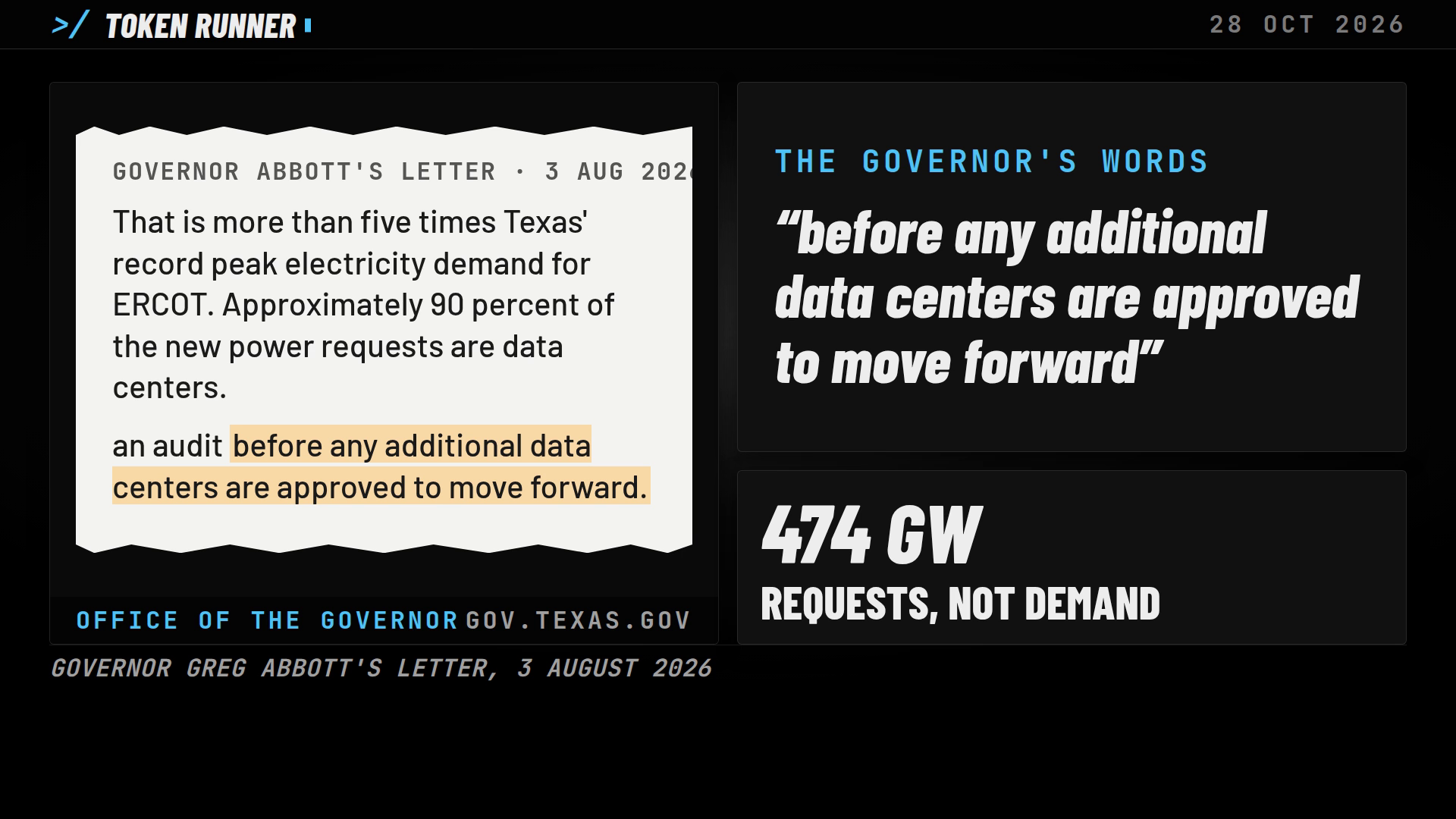
Those are requests, much of them speculative, not demand. ERCOT paused its Batch Zero study the same day. The audit report's target date is 10 December 2026, as Utility Dive reported.
Elsewhere, FERC issued show-cause orders on 18 June 2026 under the heading 'Preventing cost shifting'. Virginia created a GS-5 class for customers of 25 MW and up from 1 January 2027, with minimum payments of 85% and 60%.
The bill
So far this year, the average American household pays almost seven percent more for each unit of electricity than last year. In several of the grid's states, more: Ohio, Virginia, Maryland and Pennsylvania, up twelve to thirteen percent.
EIA's Table 5.6.B, January to August 2026 against the same months of 2025, in cents per kWh: the United States 18.19 against 17.03, +6.8%. Pennsylvania +12.0%, Maryland +12.6%, Ohio +13.0%, Virginia +13.0%. The percentages are our arithmetic from EIA's two columns; West Virginia is +1.4%.
A rate, not a bill: EIA's figure is cents per kWh.
Source: U.S. Energy Information Administration, Electric Power Monthly, Table 5.6.B (August 2026 year to date), read at source 28 October 2026
The cause
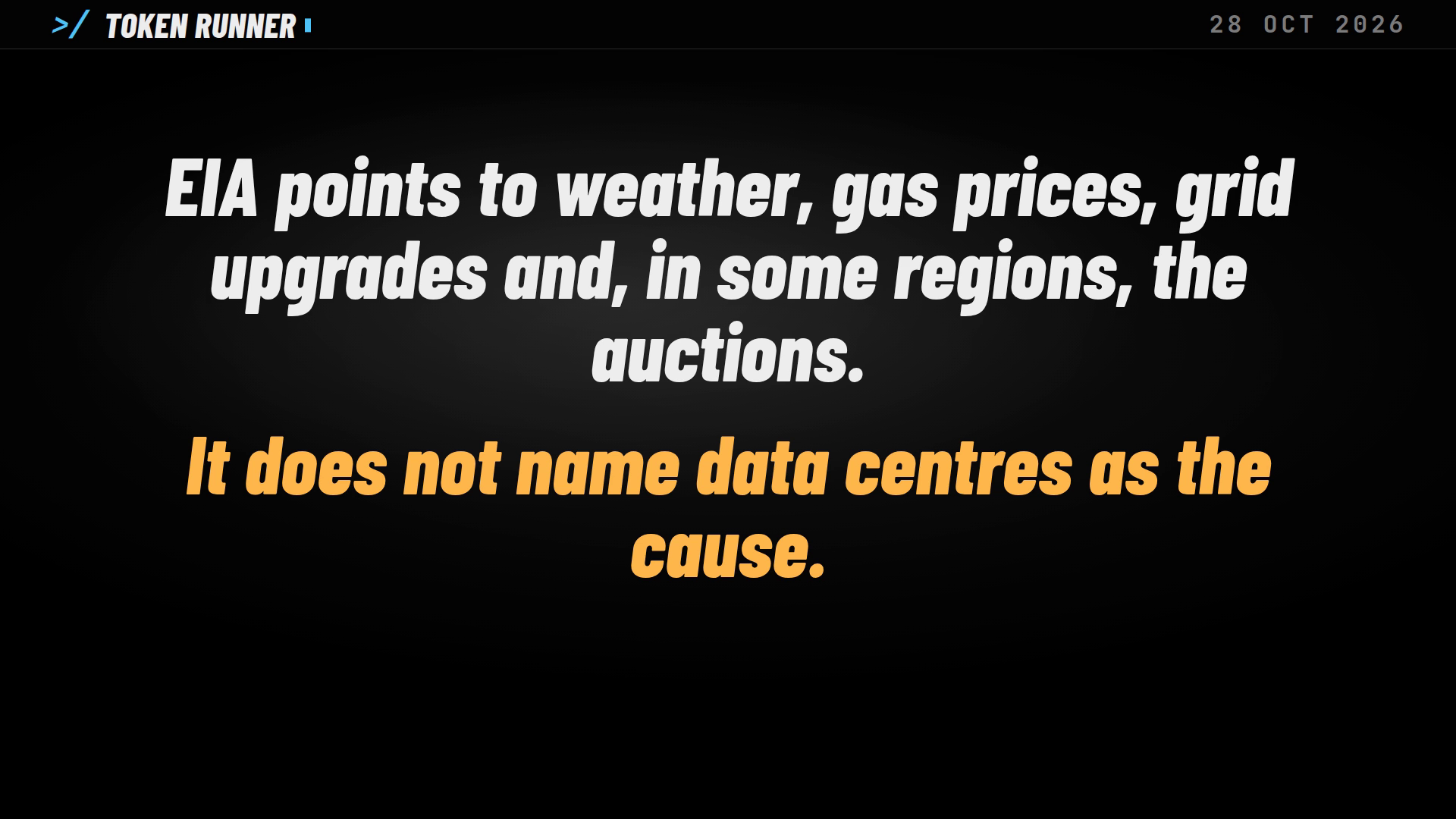
The government's statisticians don't name data centres as the cause. EIA points to weather, gas prices, grid upgrades and, in some regions, the capacity auctions.
Its outlook of 6 October 2026 forecasts PJM wholesale prices up 41% in 2026, "the largest increase across all regions", "strongly influenced by natural gas prices and weather".
PJM's own estimate of the retail effect of each auction is 1.5% to 5%, as NJBIZ reported.
Microsoft's pledge
Microsoft says it will cover its own: "We'll pay our way to ensure our datacenters don't increase your electricity prices."
Its pledge covers its own data centres. Brad Smith puts the rise elsewhere, "driven in part by several years of inflation, supply chain constraints, and long-overdue grid upgrades". Microsoft will ask utilities "to set our rates high enough".
The plants
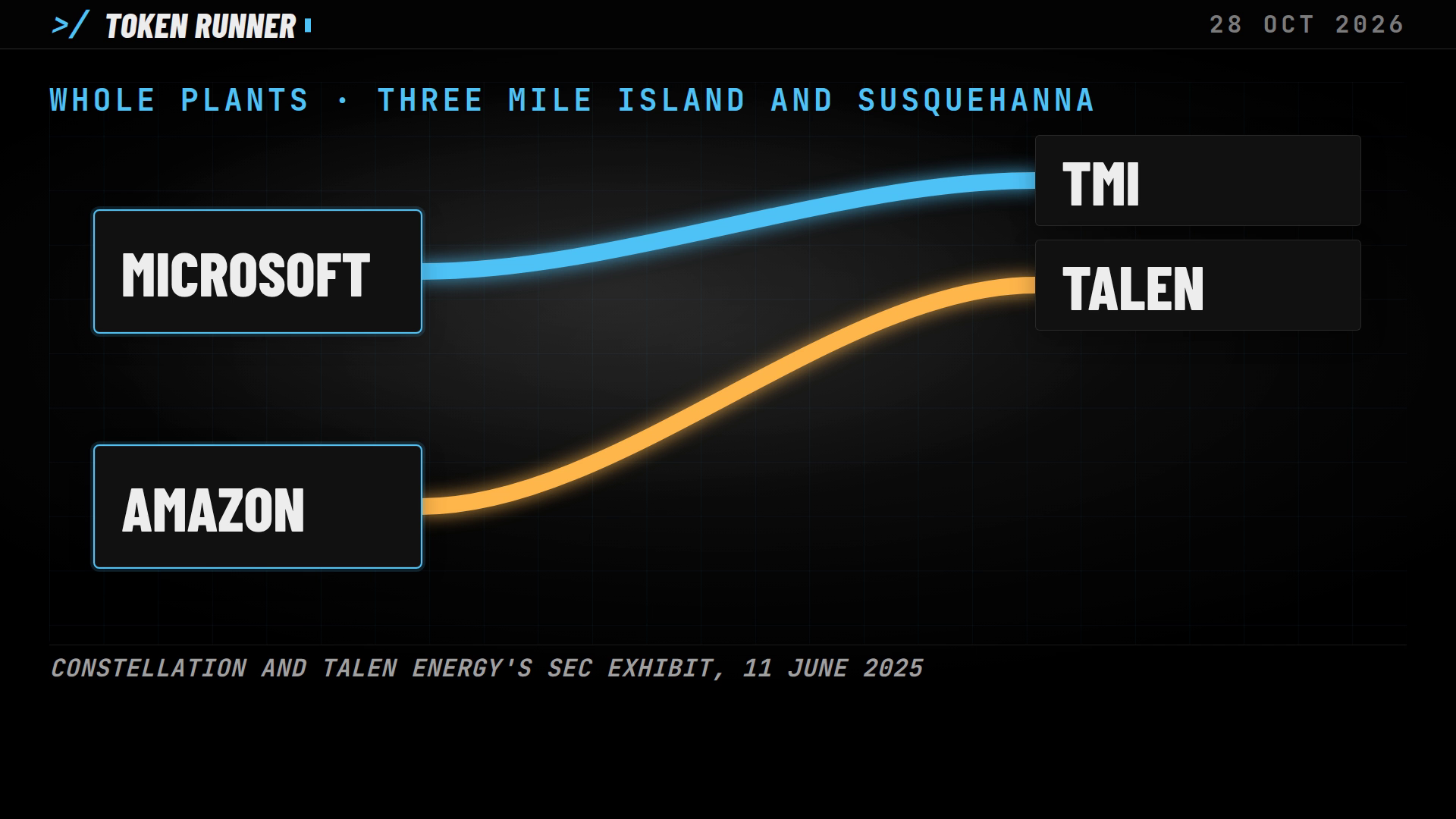
And the tech companies are signing for whole power plants: two buyers, two plants, each on a long contract. Microsoft buys the power of Three Mile Island's restarted reactor; Amazon has signed for Susquehanna's.
Constellation restarts Three Mile Island Unit 1, now the Crane Clean Energy Center, with a 2027 target. Microsoft buys the output for 20 years, delivered to the grid, so not 'for itself'.
Amazon has signed for "1,920 megawatts of carbon-free nuclear power through 2042" from Talen's Susquehanna, ramping to full by 2032, delivered to the PJM grid.
Also on the record: Google and Duane Arnold, with a DOE loan of up to $1.9 billion, the restart pending the NRC. The manufacturers' group IECA: "Unlike data centers, manufacturing electricity demand has been flat and will remain so." PJM's chief executive, David Mills: "demand for electricity continues to grow faster than electricity supply".
“demand for electricity continues to grow faster than electricity supply”
PJM's chief executive, David Mills
What we couldn't confirm
'Spoken for' means the long-term contracts above. We couldn't confirm the Texas audit's target date, or Talen and Amazon's front-of-the-meter move. Restart dates are targets.
The power plants are being spoken for. The question is who pays for the rest.
Every figure from the grid operator, its monitor, the regulators and the companies themselves. Token Runner dot A I.
Sources
- PJM Interconnection, 14 July 2026, the 2028/29 Base Residual Auction: "more than 67 million people across 13 states and the District of Columbia"; "These most recent auctions were the first in PJM history in which the entire RTO fell short of the reliability requirement." Read at source.
- PJM's auction reports: 2024/25 $28.92 per MW-day; 2025/26 $269.92; 2026/27 $329.17 (the cap; cleared 139 MW above the requirement); 2027/28 $333.44 (the cap; 6,517 MW short); 2028/29 $325 (the cap; 6,831 MW short). The cap is the FERC-approved price collar, set by PJM with the governors.
- PJM's 2024/25 Base Residual Auction report ($28.92).
- Monitoring Analytics, PJM's Independent Market Monitor, report of 28 July 2026: "of the $16.4B in capacity market charges, $6.3B was a result of data center load. This was 38.2 percent of the capacity market charges."; "$29.4B, or 46.2 percent of total capacity market charges over those four auctions"; data centres should "pay for their own capacity". Data-centre load in PJM's peak forecast, from its table: 7,927 MW (2025/26), 11,993, 17,071, 21,470 (2028/29). Estimates; PJM: "The total value does not equate to the total cost to load".
- Governor Greg Abbott's letter of 3 August 2026: "ERCOT is currently considering approximately 474 gigawatts of requests to connect to the Texas grid. That is more than five times Texas' record peak electricity demand for ERCOT. Approximately 90 percent of the new power requests are data centers."; an audit "before any additional data centers are approved to move forward." Requests, never demand. ERCOT paused its Batch Zero study; the audit report's target date, 10 December 2026, as reported (Utility Dive).
- ERCOT's market notice of 3 August 2026 (the Batch Zero pause) and its Senate panel of 29 July 2026 (the large-load figures, June 2026 data).
- U.S. Energy Information Administration, Electric Power Monthly, Table 5.6.B (released 23 October 2026), average residential price, January to August 2026 against the same months of 2025, cents per kWh: the United States 18.19 against 17.03 (+6.8%); Pennsylvania 21.13 against 18.86 (+12.0%); Maryland 21.31 against 18.93 (+12.6%); Ohio 18.81 against 16.64 (+13.0%); Virginia 16.95 against 15.00 (+13.0%). The percentages are our arithmetic from EIA's two columns. West Virginia is +1.4%.
- EIA, Short-Term Energy Outlook, 6 October 2026: residential prices shaped by weather, natural gas prices, grid upgrades and, in some regions, the capacity auctions; PJM wholesale prices forecast +41% in 2026, "the largest increase across all regions", "strongly influenced by natural gas prices and weather". EIA names no data-centre cause.
- Microsoft, Brad Smith, 13 January 2026: "We'll pay our way to ensure our datacenters don't increase your electricity prices."; rates have risen "driven in part by several years of inflation, supply chain constraints, and long-overdue grid upgrades"; Microsoft will ask utilities "to set our rates high enough".
- Constellation: the Crane Clean Energy Center (Three Mile Island Unit 1) restart, with a 20-year power purchase agreement with Microsoft, the power delivered to the grid; the 2027 target is a target (a FERC waiver of 1 June 2026).
- Talen Energy's SEC exhibit, 11 June 2025: Amazon has signed for "1,920 megawatts of carbon-free nuclear power through 2042" from Susquehanna, ramping to full by 2032, delivered to the PJM grid; the front-of-the-meter move as reported, not established.
- Utility Dive on ERCOT's data-centre audit and its target date.