Robocalls Before the Midterms
Right now, a political call made with an AI voice can't ring your cellphone unless you've agreed to it. The FCC settled that in 2024.
Weeks before the midterms, a political group asked the FCC to change that. The FCC's answer so far: "zero plans" to act.
The ask
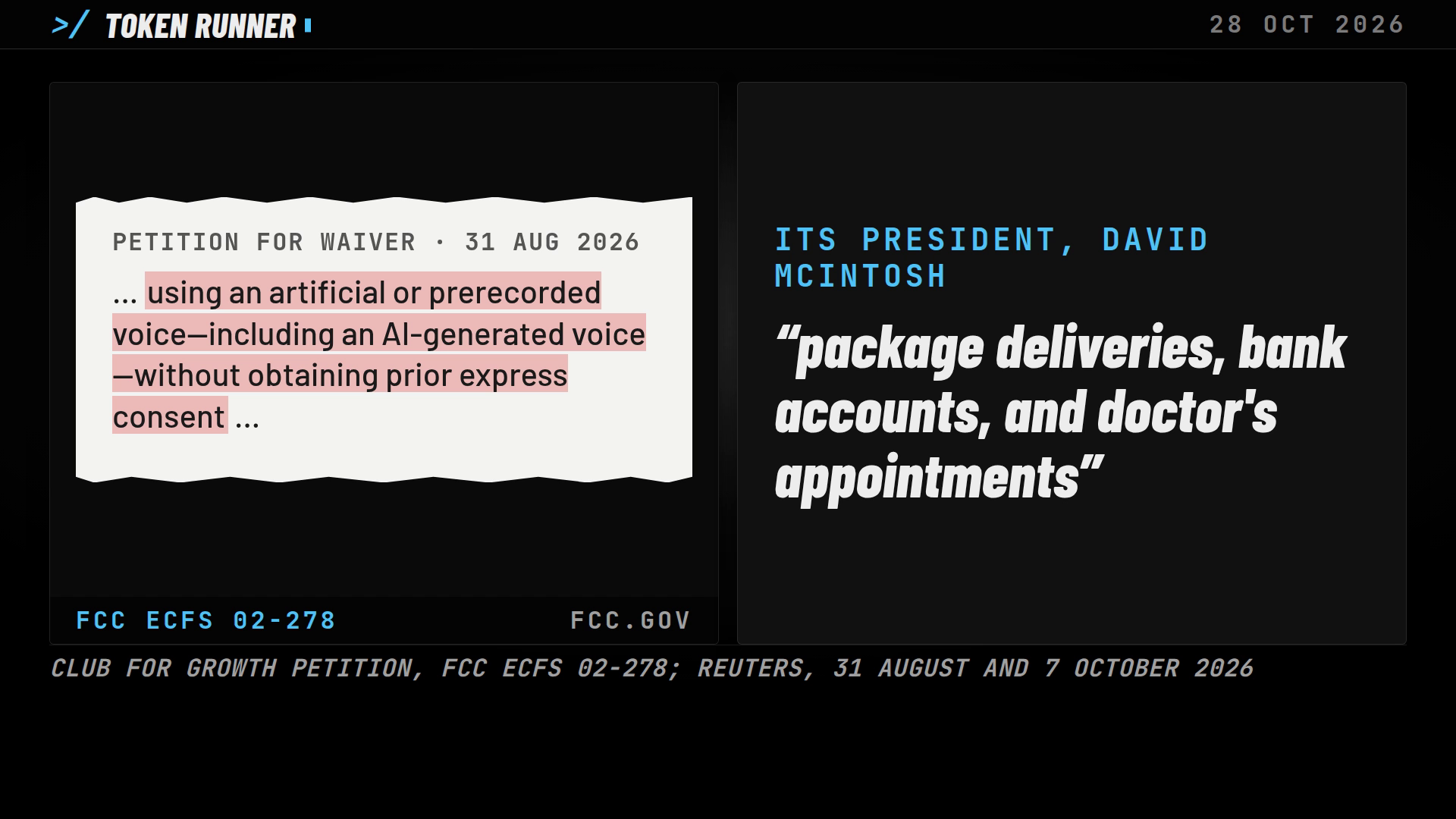
In August, the conservative group Club for Growth asked the FCC to change that before the midterms. Its petition asks to reach cellphones "using an artificial or prerecorded voice—including an AI-generated voice—without obtaining prior express consent".
Its president, David McIntosh, says political speech deserves the same treatment as "package deliveries, bank accounts, and doctor's appointments", as Reuters reported on 7 October 2026.
The FCC received the petition for waiver on 31 August 2026. Its public notice of 4 September set comments for 5 October and replies for 19 October.
The pushback
An FCC commissioner, Anna Gomez, said on 8 October 2026 that the waiver "would bring chaos so close to Election Day".
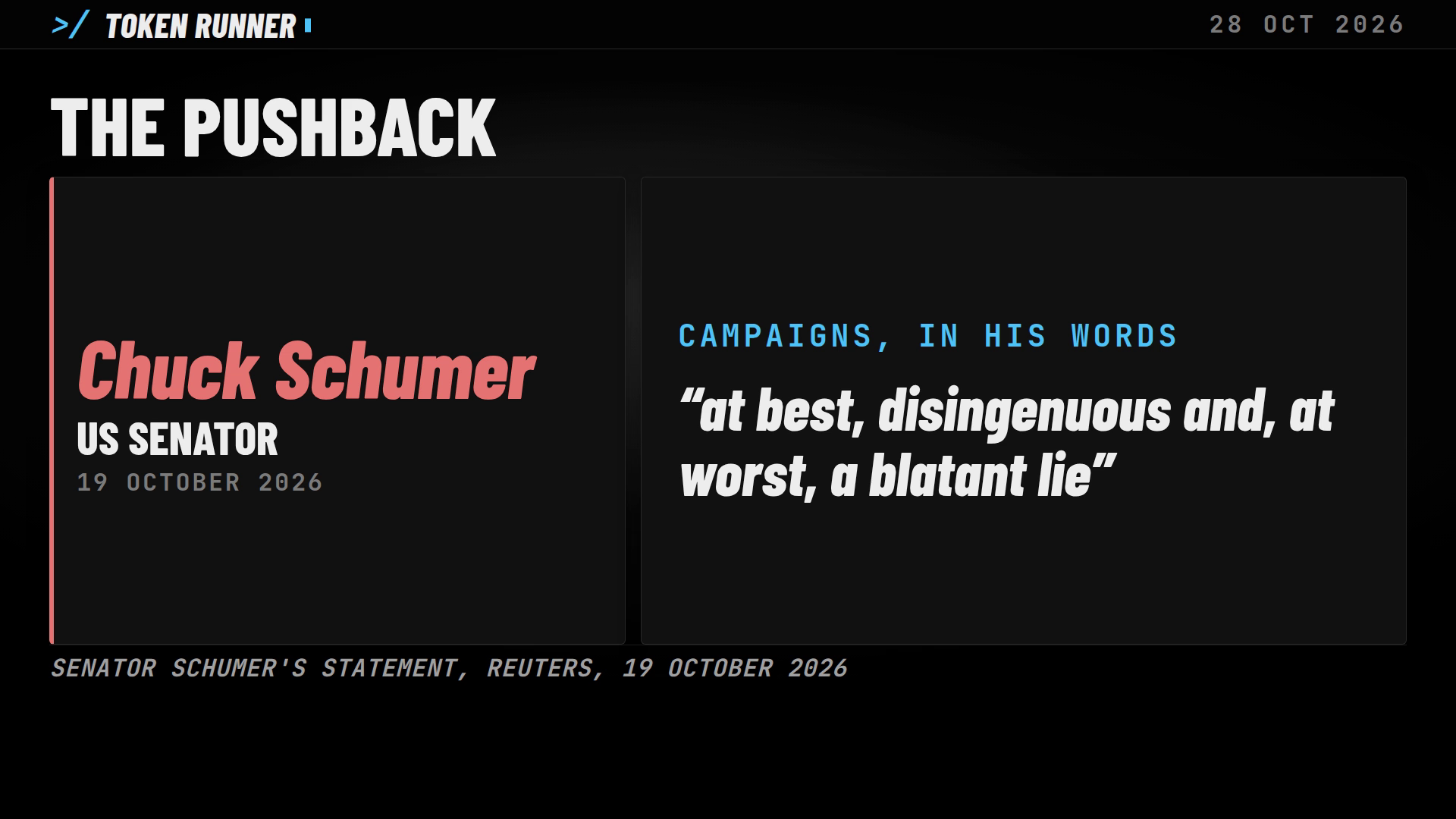
Senator Chuck Schumer: campaigns "could use their opponents' voice to send out a message that is, at best, disingenuous and, at worst, a blatant lie", as Reuters reported on 19 October.
Common Cause filed in opposition. Communications Daily names the Center for Democracy and Technology, the Campaign Legal Center and EPIC among the commenters opposed.
The answer
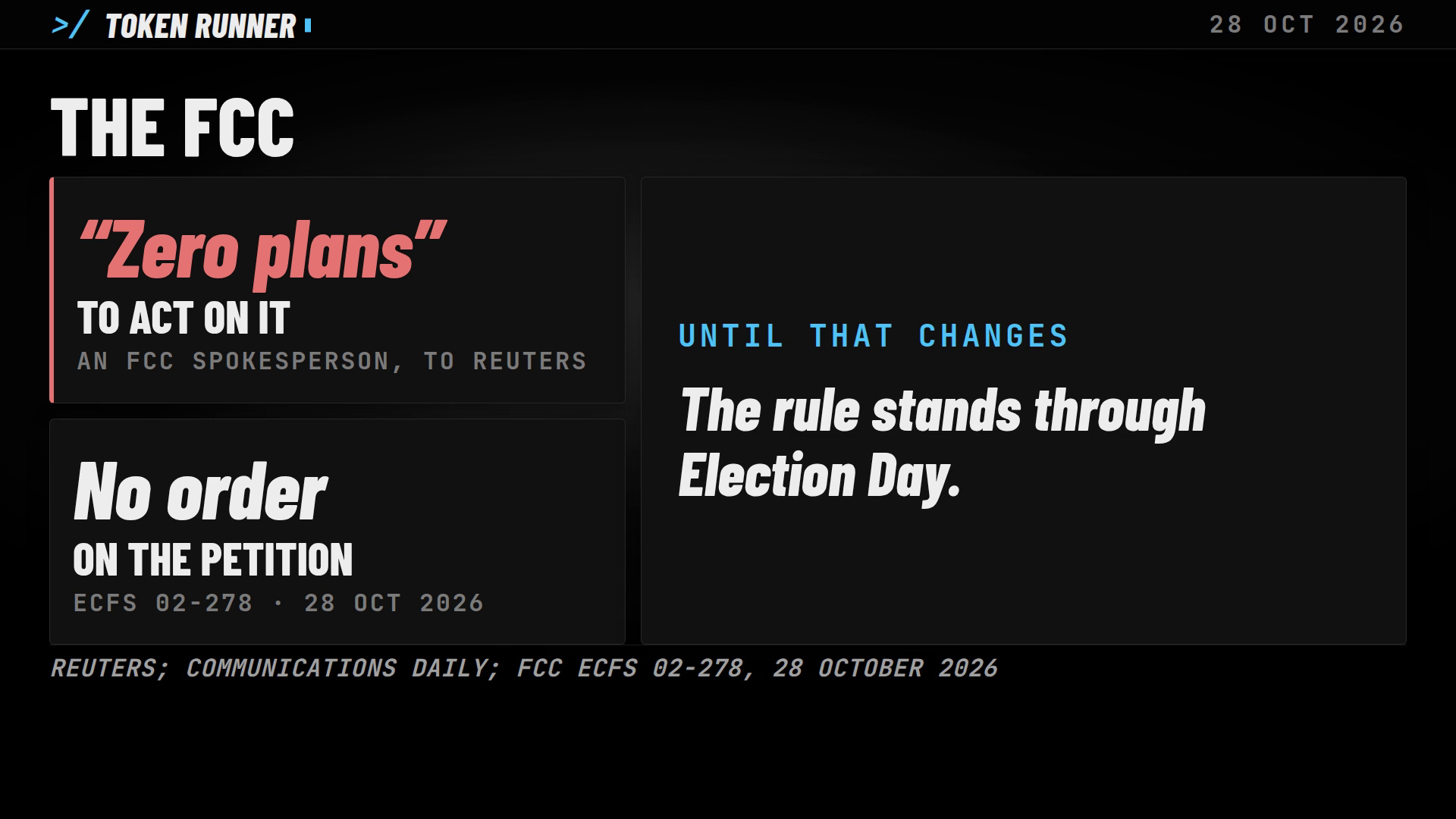
The FCC itself? A spokesperson told Reuters there are "zero plans" to act on it. Unless that changes, the rule stands through Election Day.
Reuters reported it on 19 October 2026. Its text carries a typo; Politico and Communications Daily have 'zero plans to do so'.
We re-checked the docket on 28 October 2026: no order, grant or denial on the petition. It was still 27 October in Washington at that check.
The rule
The rule that stands is the FCC's declaratory ruling of 8 February 2024, FCC 24-17. It says an AI-generated voice is "artificial" under the Telephone Consumer Protection Act, so such calls to cellphones need prior express consent.
New Hampshire
The rule has a history. In January 2024, voters in New Hampshire got a call in what appeared to be an AI clone of President Biden's voice, telling them to save their vote for November. The FCC fined the consultant behind it six million dollars. A civil court found him liable. A criminal jury acquitted him on every count.
Each step comes from the document that states it. The calls went out on 21 January 2024; the count, 5,000 to 25,000, is Nomorobo's estimate as the state's Department of Justice quoted it. The FCC's ruling followed on 8 February 2024, and the carrier Lingo's $1 million civil penalty on 21 August 2024.
The $6 million forfeiture against the consultant came on 26 September 2024 (FCC 24-104). A civil consent judgment for other defendants followed on 29 May 2025, his acquittal on all 22 criminal counts on 13 June 2025, and a civil default judgment and injunction against him on 20 November 2025.
Source: The FCC's own documents (FCC 24-17, FCC 24-104, the Lingo consent decree), the US District Court for New Hampshire, the New Hampshire DOJ, ECFS 02-278 and Reuters (19 October 2026), read at source 28 October 2026
The states
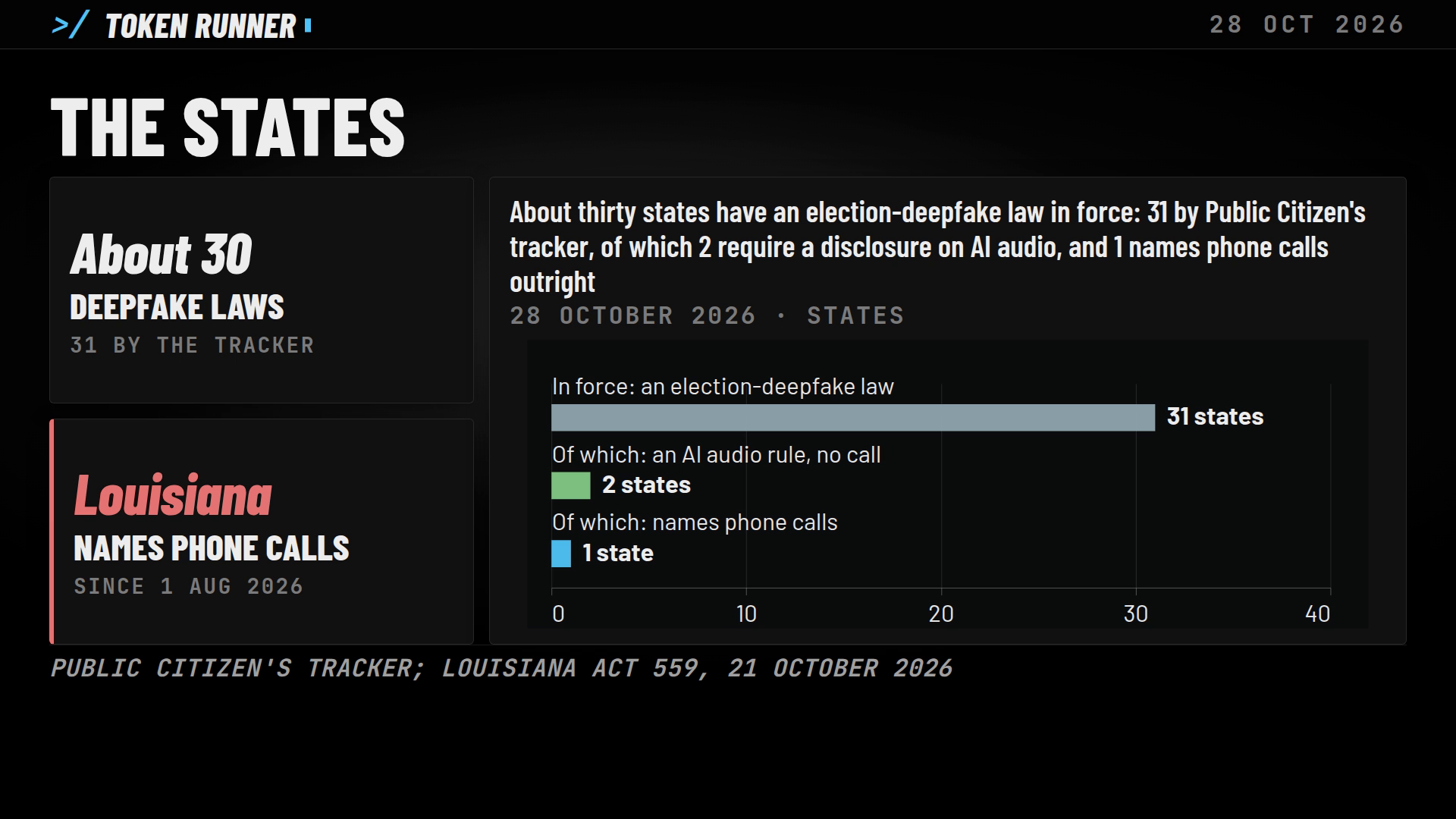
So the states are writing their own rules. About thirty now have election-deepfake laws, by Public Citizen's count. Louisiana's law, in force since August, names phone calls outright: an AI call in a public figure's voice must say so at the start.
Public Citizen's tracker, updated 21 October 2026, counted at source: 31 states with an election-deepfake law in force. That is 33 'Enacted' entries less Hawaii, struck down, and Massachusetts, sunset; Illinois, folded into an omnibus, is not counted. Public Citizen's own headline of May said 30.
Louisiana's Act 559 was signed on 29 May 2026 and has been in force since 1 August 2026.
Source: Public Citizen, 'Tracker: Legislation on Deepfakes in Elections', updated 21 October 2026; the Louisiana, Tennessee and Vermont statutes; read at source 28 October 2026
Tennessee and Vermont require a disclosure at the start and end of AI audio, but neither text says 'call'. Whether they reach calls is not established. In Mississippi, the attorney general wrote to the Colom campaign in October 2026 over AI-generated ads: video, not calls.
What we couldn't confirm
Nomorobo's call estimate at Nomorobo itself; we have it as the New Hampshire Department of Justice's release quoted it. Whether Tennessee's and Vermont's laws reach phone calls in practice. Any FCC action dated 28 October in Washington, since the check ran while it was still 27 October there.
The phone in your pocket is still off-limits to AI campaign calls, unless you've said yes. For now.
Every quote from the FCC's own documents, the petition, and the people who spoke on the record. Token Runner dot A I.
Sources
- Club for Growth, Petition for Waiver, FCC ECFS proceeding 02-278, filing 26110073991, received 31 August 2026: to reach cellphones "using an artificial or prerecorded voice—including an AI-generated voice—without obtaining prior express consent" (the petition's em dashes as filed). FCC Public Notice DA 26-940, 4 September 2026: comments 5 October, replies 19 October.
- Commissioner Anna Gomez's statement, 8 October 2026, that the waiver "would bring chaos so close to Election Day": the FCC's own release.
- David McIntosh, Club for Growth's president, that political speech deserves the same treatment as "package deliveries, bank accounts, and doctor's appointments", and the joint comment of consumer groups in opposition: Reuters, 7 October 2026, as carried by CNA.
- Senator Chuck Schumer's statement, that campaigns "could use their opponents' voice to send out a message that is, at best, disingenuous and, at worst, a blatant lie": Reuters, 19 October 2026, as carried by StreetInsider.
- Common Cause, 'Fighting AI robocalls ahead of the midterms', 7 October 2026: its own filing in opposition.
- An FCC spokesperson: the FCC has "zero plans" to act on the petition (Reuters, 19 October 2026, whose text has the typo 'to so'; Communications Daily, 21 October 2026, linked, carries 'zero plans to do so' and names the Center for Democracy and Technology, the Campaign Legal Center and EPIC among the commenters opposed). The FCC's 2024 ruling, FCC 24-17 (8 February 2024): an AI-generated voice is "artificial" under the TCPA, so such calls to cellphones need prior express consent. ECFS 02-278 re-checked 28 October 2026 about 02:47 JST: no order, grant or denial on the petition; the newest item an unrelated notice of 27 October (DA 26-1159).
- The FCC's declaratory ruling of 8 February 2024, FCC 24-17: an AI-generated voice is "artificial" under the TCPA.
- The New Hampshire case, each step from the document that states it: the calls of 21 January 2024 (the NH Department of Justice; the count, 5,000 to 25,000, is Nomorobo's estimate as the DOJ release quoted it); FCC 24-17, 8 February 2024; Lingo Telecom's $1 million civil penalty (the FCC's consent decree, 21 August 2024); the $6 million forfeiture against the consultant (FCC 24-104, 26 September 2024); the League of Women Voters' civil consent judgment for other defendants (29 May 2025); the consultant's acquittal on all 22 criminal counts (13 June 2025); a civil default judgment and injunction (US District Court for New Hampshire, 20 November 2025). Never 'convicted'.
- Public Citizen, 'Tracker: Legislation on Deepfakes in Elections', last updated 21 October 2026, counted at source: 31 states with an election-deepfake law in force (33 'Enacted' entries less Hawaii, struck down, and Massachusetts, sunset February 2025; Illinois, folded into an election omnibus in May 2026, not counted): AL AZ CA CO DE FL ID IN KY LA ME MD MI MN MS MT NV NH NM NY ND OR PA RI SD TN TX UT VT WA WI. Public Citizen's own headline of 13 May 2026 said 30.
- Louisiana Act 559 (HB 639, 2026 Regular Session), signed 29 May 2026, in force since 1 August 2026 (the legislature's bill history), R.S. 18:1463.1(D): an AI call in a public figure's voice must say so at the start. Tennessee Public Chapter 625 (effective 1 July 2026) and Vermont 17 V.S.A. § 2032 require a disclosure at the start and end of AI audio; neither text says 'call'; whether they reach calls is not established.
- The Mississippi attorney general's letter to the Colom campaign over AI-generated ads, October 2026 (video, not calls).