Teaching AI to Do Your Job
In April, Meta told its American staff it would start recording how they use their work computers: mouse movements, clicks, keystrokes and screenshots.
Meta's reason
Meta recorded its own staff's clicks and keystrokes to teach AI to do their work. Elsewhere, doctors, lawyers and bankers are paid by the hour to train the AI that may replace them.
Meta gave its reason in its own words: "our models need real examples of how people actually use them." Its chief technology officer, Andrew Bosworth, wrote in a memo: "our agents primarily do the work and our role is to direct, review and help them improve."
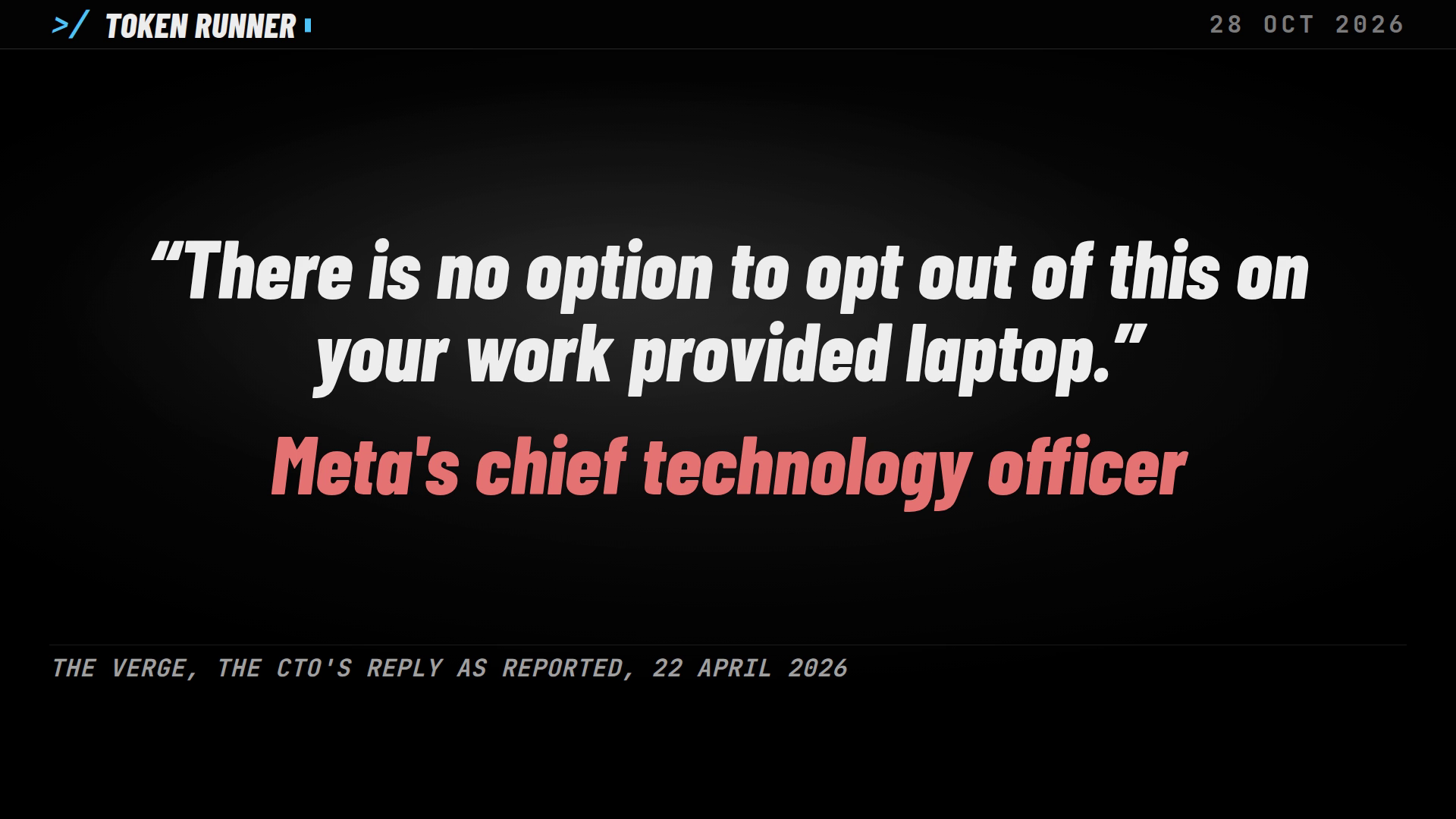
An employee asked about opting out. Bosworth replied: "There is no option to opt out of this on your work provided laptop."
Meta's statement to The Verge, in full: "our models need real examples of how people actually use them — things like mouse movements, clicking buttons, and navigating dropdown menus", with the company saying the data is not used for any other purpose. Both lines from Bosworth are as reported by The Verge; the memo's full sentence is "The vision we are building towards is one where our agents primarily do the work and our role is to direct, review and help them improve." Meta disputed neither. The accounts of whether the recorded data trained any model contradict each other, so we make no claim either way.
Suspended, not ended
Staff pushed back. A petition gathered more than 1,500 signatures, then more than 1,800.
In April Meta also told staff it would cut about 10 percent of its workforce; the cuts came in May. In June some of the recorded data was found exposed to other staff, and Meta suspended the program. In September it was still suspended. Meta says any return will be optional.
Source: The Verge (22 April 2026), the BBC (23 April and 3 June 2026), WIRED (14 May and 22 June 2026) and Business Insider (11 September 2026), read at source 28 October 2026
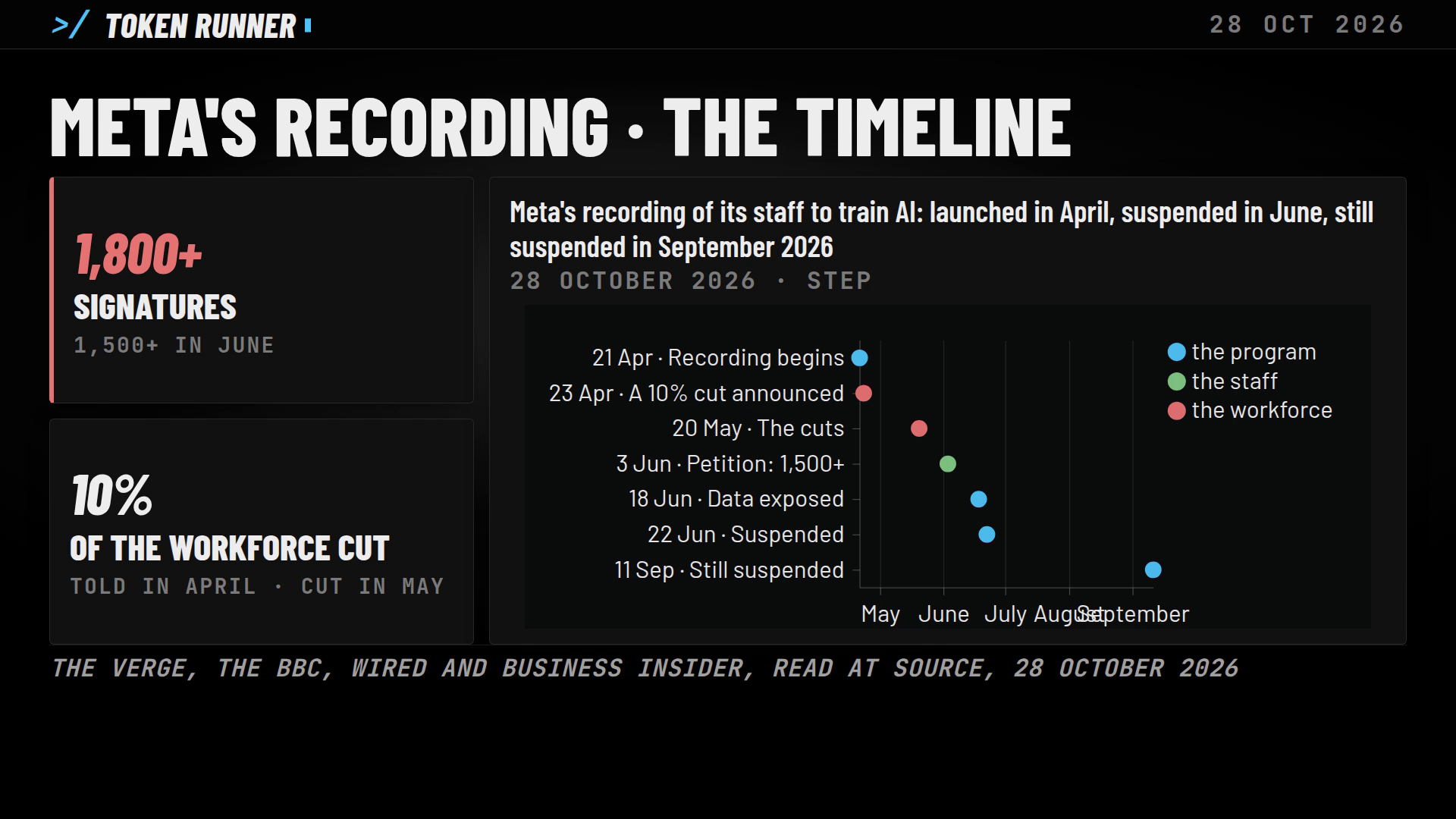
Launched in April (The Verge, with Meta's statement); a cut of about 10% of the workforce, roughly 8,000 staff, announced in a memo on 23 April (BBC) and made on 20 May (WIRED); a staff petition of more than 1,500 signatures (BBC, 3 June). Some of the data was found accessible to more people than intended on 18 June, and the program was paused on 22 June (WIRED); Meta said it had "no indication at this time that any data was improperly accessed by Meta employees". Still suspended on 11 September, with a return said to be optional and over 1,800 signatures (Business Insider). We found no newer status after 11 September.
The pay
Outside the big firms, teaching AI has become a job of its own. Professionals are paid by the hour to write the tasks and grade the answers.
Typical trainers, 60 Minutes reported, earn anywhere from $20 to $200 an hour. One platform, Mercor, says it pays out more than $2 million a day.
Source: 60 Minutes (CBS, 4 October 2026), Mercor's own listings (read 28 October 2026) and WIRED (15 September 2025), read at source 28 October 2026
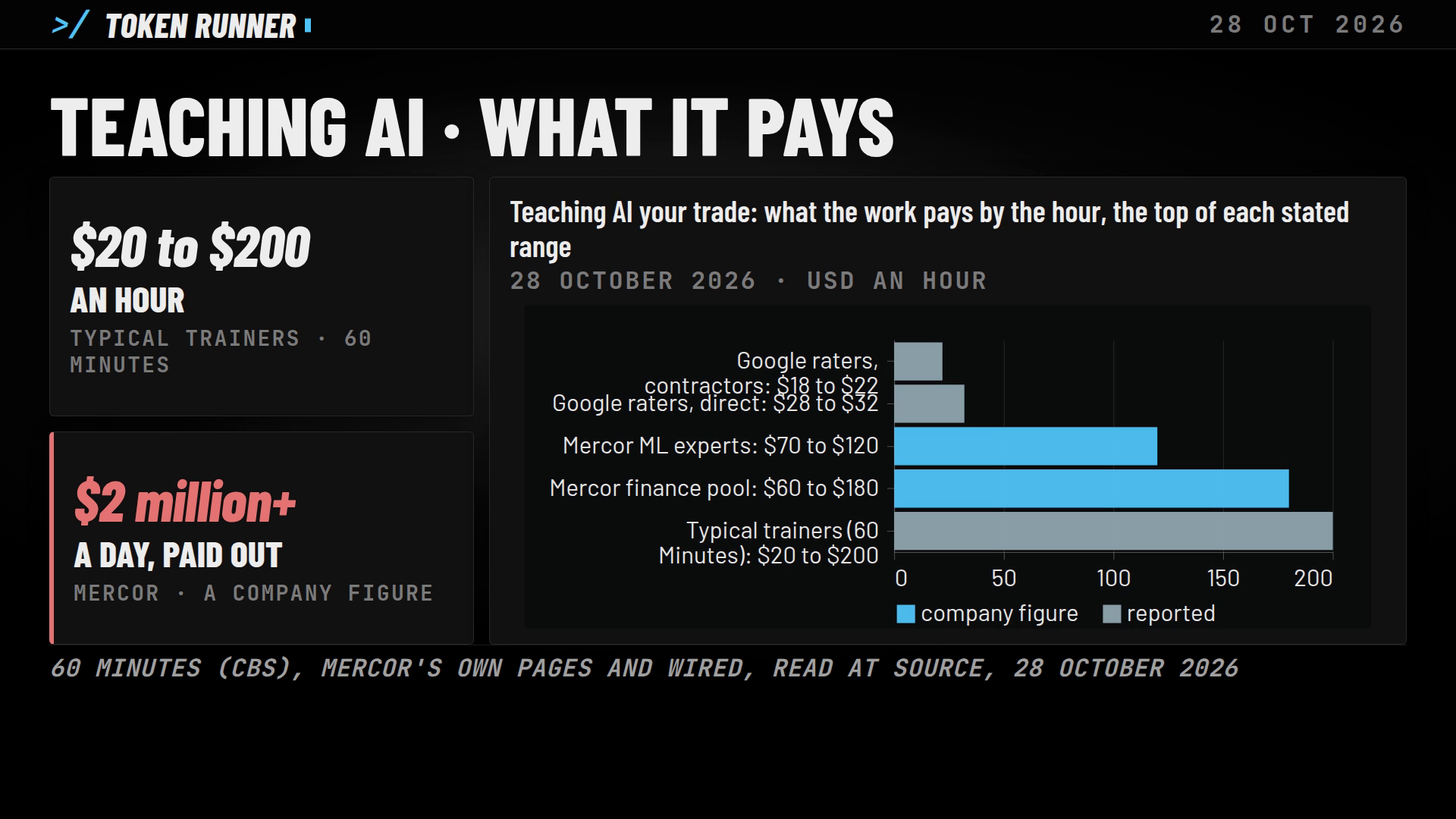
Typical trainers, $20 to $200 an hour, as 60 Minutes reported (4 October 2026). Mercor's own listings, company figures read 28 October 2026: machine-learning experts $70 to $120, its finance pool $60 to $180. Mercor says it pays out more than $2 million a day (its blog, 8 May 2026, a company figure).
Who does the work
The trainers are experts. CNN reported in February on doctors, lawyers and finance professionals hired to train AI in their own fields.
Where they are hired matters. WIRED found Google's raters paid $18 to $22 an hour through contractors, and $28 to $32 when hired direct.
The job is growing. LinkedIn counts data annotators among the 25 fastest-growing roles in the United States in 2026.
Both sides
Mercor's chief executive, Brendan Foody, told 60 Minutes: "you're changing human work… I think that evolution is natural."
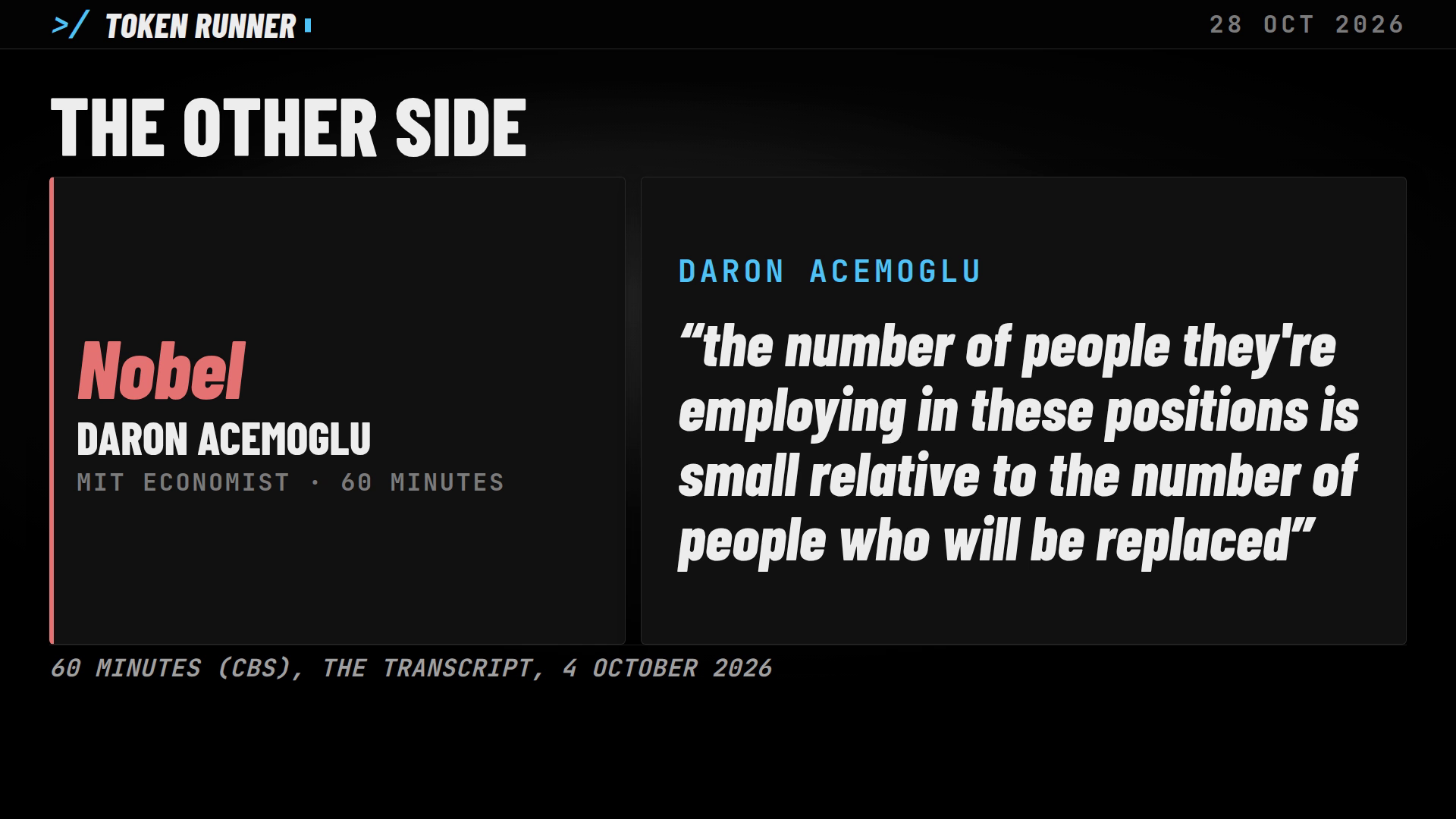
The MIT economist Daron Acemoglu, a Nobel laureate, answered on the same programme: "the number of people they're employing in these positions is small relative to the number of people who will be replaced. I mean, that's the whole point of automation."
Foody, in full as CBS aired it: "Well, I think that you're changing human work. It might not necessarily be that repetitive task… And so I think that evolution is natural." (4:33 to 4:47.) Acemoglu from 11:56 to 12:12 of the same programme; his sentence begins "Because the number of people they're employing…".
When it ends
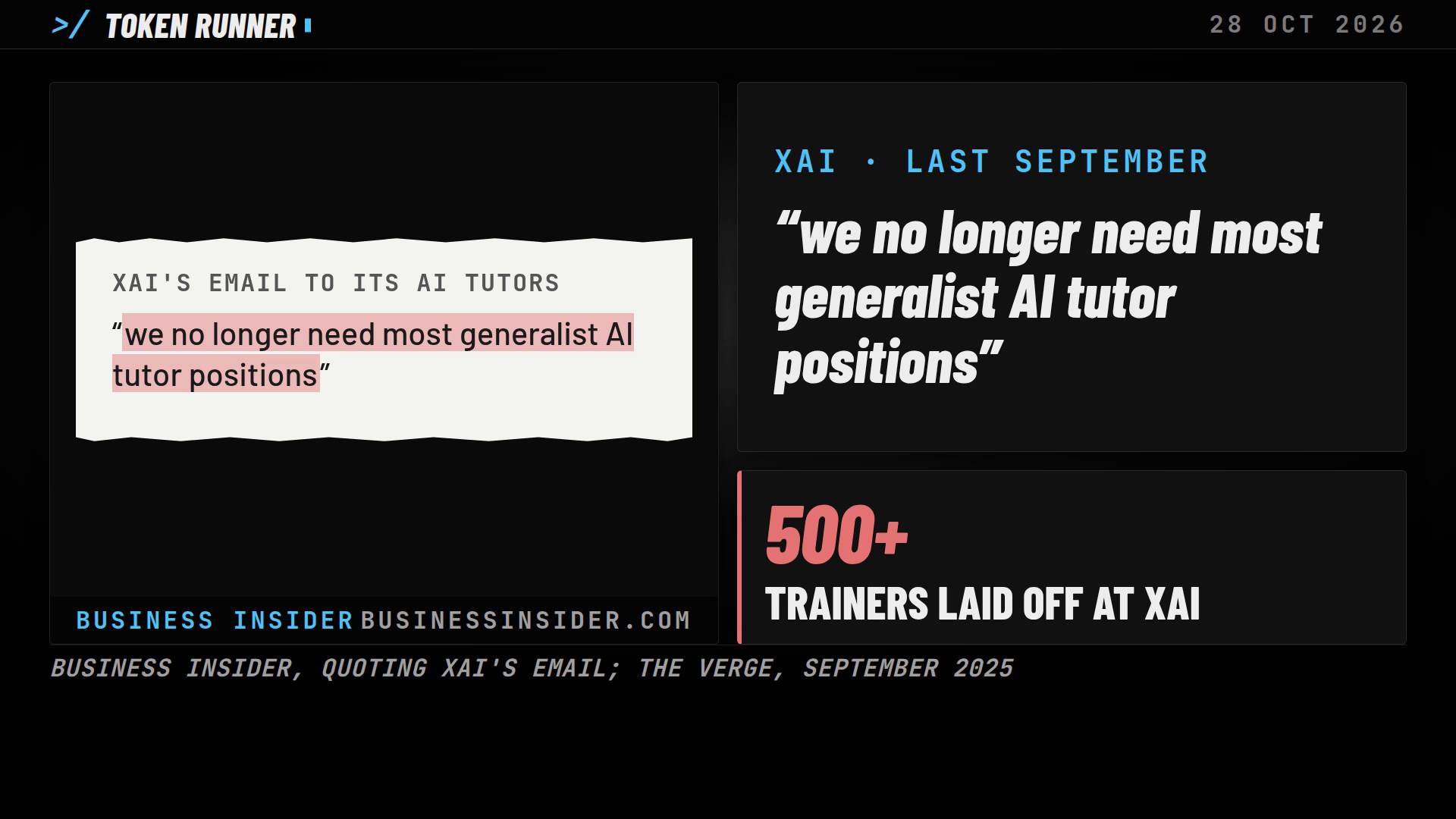
And the work can stop overnight. In September 2025, Elon Musk's xAI told its AI tutors: "we no longer need most generalist AI tutor positions." More than 500 lost their jobs.
xAI's email of 12 September 2025, as quoted by Business Insider: "As part of this shift in focus, we no longer need most generalist AI tutor positions and your employment with xAI will conclude." The same email said xAI would "accelerate the expansion and prioritization of our specialist AI tutors". The Verge counted more than 500 laid off.
The lesson
The machines are learning the job from the people who do it. The question is who's still employed when the lesson's over.
Two things to watch. Whether Meta's recording comes back, and on what terms. And whether the experts' hourly rates hold as the specialist work grows.
What we couldn't confirm: Reuters' own wording on the recording, as its reports are paywalled, and any change to the program's status after 11 September.
Every quote from the companies' own words and the reporters who covered them. Token Runner dot A I.
Sources
- The Verge, 22 April 2026, with Meta's statement (spokesperson Tracy Clayton) and Andrew Bosworth's memo and reply as reported. Read at source.
- BBC News, 23 April 2026, on Meta's memo planning to cut 10% of its workforce. Read at source.
- BBC News, 3 June 2026: the staff petition of more than 1,500 signatures. Read at source.
- WIRED, 14 May 2026, on the layoffs set for 20 May. Read at source.
- WIRED, 22 June 2026, on the pause after some data was found accessible to more people than intended. Read at source.
- Business Insider, June 2026, on the data exposure. Read at source.
- Business Insider, 11 September 2026: the program still suspended, a return said to be optional, over 1,800 signatures. Read at source.
- WIRED, 2025, on Google's 'super raters': $18 to $22 an hour via third-party contractors, $28 to $32 hired direct. Read at source.
- Mercor's machine-learning listing, read 28 October 2026: 'Comparable machine learning projects have posted at $70 to $120 an hour' (a company figure).
- Mercor's finance pool page, read 28 October 2026: listings 'from $60 to $180 an hour' (a company figure).
- Mercor's blog, 8 May 2026: 'we pay out over $2 million every day to more than 30,000 weekly active contractors' (a company figure).
- 60 Minutes, 4 October 2026, CBS's transcript: Brendan Foody and Daron Acemoglu; 'typical trainers can be paid anywhere from $20 to $200 an hour'.
- 60 Minutes, 4 October 2026, the segment on YouTube: Foody at 4:33 to 4:47, Acemoglu at 11:56 to 12:12.
- CNN, 17 February 2026, on experts in medicine, law and finance training AI. Read at source.
- Conversations with Tyler, Brendan Foody. Read at source.
- Business Insider, 13 September 2025, quoting xAI's email to its AI tutors. Read at source.
- The Verge, September 2025: xAI laid off more than 500 people who trained its chatbot. Read at source.
- LinkedIn, Jobs on the Rise 2026, 7 January 2026: the 25 fastest-growing US roles. Read at source.